Consider the titration of 60.0 mL of 0.150 M HNO3 with 0.450 M NaOH.(a) How many millimoles of HNO3 are present at the start of the titration?(b) How many milliliters of NaOH are required to reach the equivalence point?(c) What is the pH at the equivalence point? (d) Sketch the general shape of the pH titration curve.
Verified step by step guidance
1
(a) Calculate the millimoles of HNO3: Use the formula: \( \text{millimoles} = \text{volume (mL)} \times \text{molarity (M)} \). Substitute the given values: \( 60.0 \text{ mL} \times 0.150 \text{ M} \).
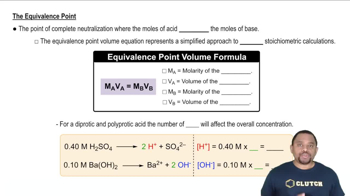
(b) Determine the volume of NaOH needed to reach the equivalence point: At the equivalence point, the millimoles of HNO3 will equal the millimoles of NaOH. Use the formula: \( \text{volume of NaOH (mL)} = \frac{\text{millimoles of HNO3}}{\text{molarity of NaOH (M)}} \).
(c) Calculate the pH at the equivalence point: Since HNO3 is a strong acid and NaOH is a strong base, the solution at the equivalence point will be neutral, and the pH will be 7.0.
(d) Sketch the titration curve: The pH titration curve will start at a low pH (acidic) and rise sharply at the equivalence point, then level off at a higher pH (basic).
Note: The equivalence point for a strong acid-strong base titration is typically at pH 7, and the curve will have a steep vertical section at this point.
Verified video answer for a similar problem:
This video solution was recommended by our tutors as helpful for the problem above.
Video duration:
3m
Play a video:
Was this helpful?
Key Concepts
Here are the essential concepts you must grasp in order to answer the question correctly.
Titration and Equivalence Point
Titration is a quantitative analytical method used to determine the concentration of a solute in a solution. The equivalence point occurs when the amount of titrant added is stoichiometrically equivalent to the amount of substance being titrated. In this case, it is the point at which the moles of NaOH added completely neutralize the moles of HNO3 present.
Molarity (M) is a measure of concentration defined as the number of moles of solute per liter of solution. Millimoles (mmol) are a smaller unit, where 1 mmol equals 0.001 moles. To find the number of millimoles of HNO3 in the solution, one can multiply the molarity by the volume in liters, allowing for easy calculations in titration problems.
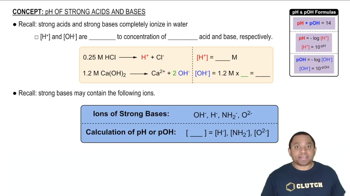
pH is a measure of the acidity or basicity of a solution, calculated as the negative logarithm of the hydrogen ion concentration. At the equivalence point of a strong acid-strong base titration, the pH is typically around 7 due to the complete neutralization of the acid and base. Understanding how to calculate pH at this point is crucial for interpreting titration results.