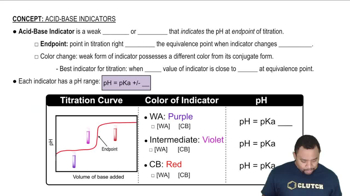
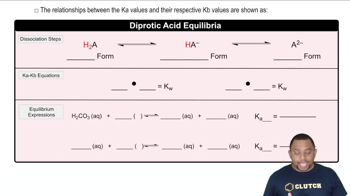
The pH titration curve applies to the titration of 40.0 mL of a 0.100 M solution of an acid with 0.100 M NaOH. What are the approximate pKa values for this acid? (a) pKa1 = 5, pKa2 = 10(b) pKa1 = 7, pKa2 = 11(c) pKa1 = 5, pKa2 = 10, pKa3 = 13 (d) pKa1 = 5, pKa2 = 7, pKa3 = 10
Verified step by step guidance
1
Identify the regions of the titration curve where the pH changes rapidly. These are the equivalence points.
Determine the volume of NaOH added at each equivalence point by looking at the steepest parts of the curve.
Find the midpoint of each buffer region, which is halfway between the equivalence points. The pH at these midpoints corresponds to the pKa values.
Estimate the pH values at these midpoints from the graph.
Compare the estimated pKa values with the given options to determine the correct answer.
Verified video answer for a similar problem:
This video solution was recommended by our tutors as helpful for the problem above.
Video duration:
2m
Play a video:
0 Comments
Was this helpful?
Key Concepts
Here are the essential concepts you must grasp in order to answer the question correctly.
Titration and pH Curves
Titration is a technique used to determine the concentration of an unknown solution by reacting it with a solution of known concentration. The pH curve represents the change in pH as a titrant is added, showing distinct regions where the pH changes rapidly, indicating the presence of equivalence points. These points correspond to the complete neutralization of the acid by the base, which is crucial for determining the pKa values of the acid.
The pKa value is a measure of the strength of an acid, defined as the negative logarithm of its acid dissociation constant (Ka). It indicates the pH at which half of the acid is dissociated, providing insight into the acid's ability to donate protons. In a titration curve, the pKa values can be identified at the inflection points where the pH changes most dramatically, corresponding to the acid's dissociation stages.
Diprotic acids are acids that can donate two protons (H+) per molecule during the titration process. They exhibit two distinct pKa values, corresponding to the two stages of dissociation. The titration curve for a diprotic acid will show two equivalence points, each associated with the loss of one proton, allowing for the determination of both pKa values from the curve.




 Verified step by step guidance
 01:35
01:35