Identify the location of the element in period 4, group 6A and classify it as a metal, nonmetal, or semimetal. (LO 2.2) (a) Element in position a; nonmetal (b) Element in position b; metal (c) Element in position c; semimetal (d) Element in position d; metal
Verified step by step guidance
1
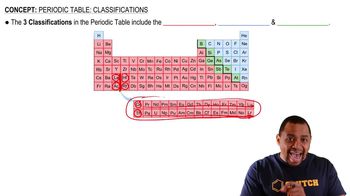
Identify the periodic table's structure, where periods are horizontal rows and groups are vertical columns.
Locate period 4 on the periodic table, which includes elements from potassium (K) to krypton (Kr).
Find group 6A (or group 16 in the IUPAC numbering system), which includes elements like oxygen (O), sulfur (S), and selenium (Se).
Determine the element in period 4, group 6A, which is selenium (Se).
Classify selenium (Se) as a nonmetal based on its properties and position in the periodic table.
Verified video answer for a similar problem:
This video solution was recommended by our tutors as helpful for the problem above.
Video duration:
1m
Play a video:
Was this helpful?
Key Concepts
Here are the essential concepts you must grasp in order to answer the question correctly.
Periodic Table Organization
The periodic table is organized into periods (rows) and groups (columns) that categorize elements based on their atomic structure and properties. Elements in the same group often exhibit similar chemical behaviors, while those in the same period have the same number of electron shells. Understanding this organization is crucial for identifying the location and classification of elements.
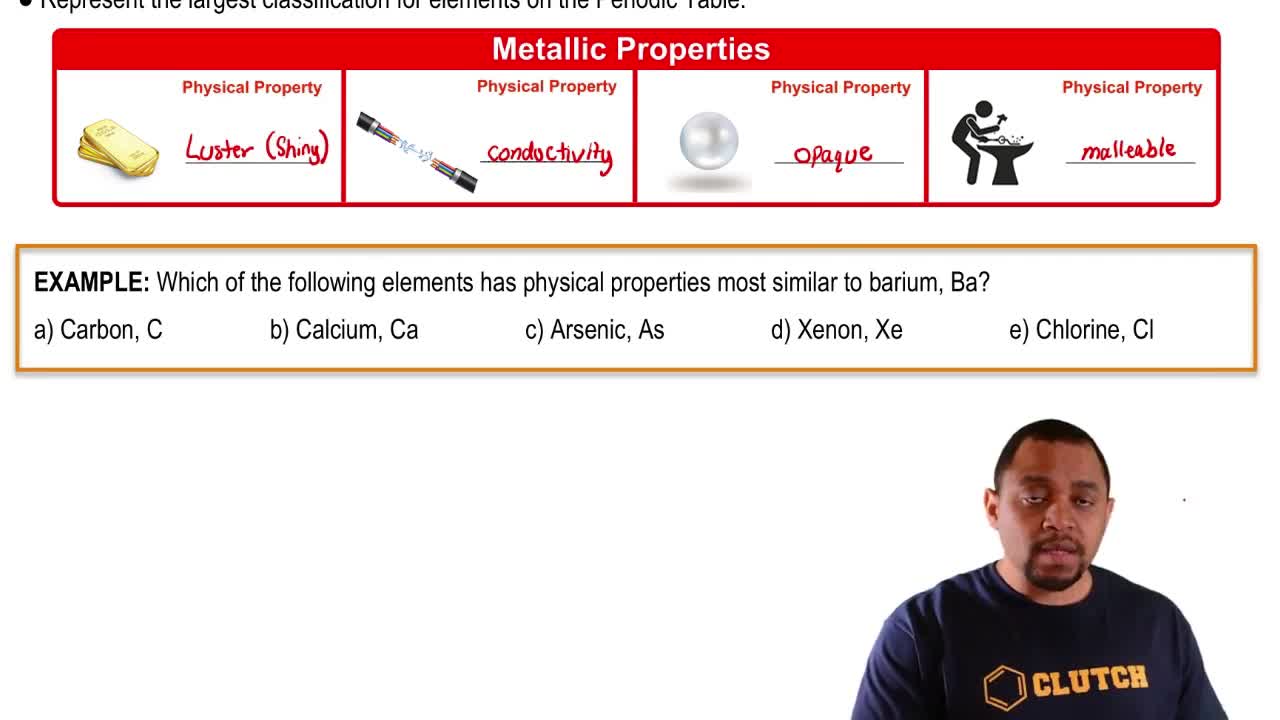
Elements are classified as metals, nonmetals, or semimetals (metalloids) based on their physical and chemical properties. Metals are typically conductive, malleable, and ductile, while nonmetals are usually poor conductors and more brittle. Semimetals exhibit properties of both metals and nonmetals, making their classification essential for understanding their behavior in reactions.
Group 6A of the periodic table, also known as the chalcogens, includes elements like oxygen, sulfur, and selenium. These elements typically have six valence electrons and can form various compounds, often exhibiting nonmetallic characteristics. Identifying the specific element in period 4, group 6A is key to determining its classification and properties.