Which description of an element is incorrectly matched with its location in the periodic table? (LO 2.5–2.6) (a) Element 3—An element in the transition metal group that is a good conductor of electricity. (b) Element 2—An element that is in the halogen group and does not conduct electricity.(c) Element 4—An element in alkali metal group that is found in its pure form in nature. (d) Element 1—An element that is a solid at room tempera-ture, brittle, and a poor conductor of electricity.
Verified step by step guidance
1
Identify the elements based on their positions in the periodic table: Element 1 is in Group 15 (nonmetals), Element 2 is in Group 17 (halogens), Element 3 is in Group 3 (transition metals), and Element 4 is in Group 1 (alkali metals).
Review the properties of each group: Group 15 elements are typically brittle and poor conductors, Group 17 elements are nonmetals and do not conduct electricity, Group 3 elements are transition metals and good conductors, and Group 1 elements are alkali metals and highly reactive, not found in pure form in nature.
Compare the given descriptions with the properties of the elements: Element 1 is described as a solid, brittle, and poor conductor, which matches Group 15. Element 2 is described as a non-conducting halogen, which matches Group 17. Element 3 is described as a good conductor and transition metal, which matches Group 3. Element 4 is described as an alkali metal found in pure form, which does not match Group 1 properties.
Identify the incorrect description: The description of Element 4 as an alkali metal found in pure form in nature is incorrect because alkali metals are highly reactive and not found in pure form in nature.
Conclude that the incorrect match is option (c) for Element 4.
Verified video answer for a similar problem:
This video solution was recommended by our tutors as helpful for the problem above.
Video duration:
1m
Play a video:
Was this helpful?
Key Concepts
Here are the essential concepts you must grasp in order to answer the question correctly.
Periodic Table Groups
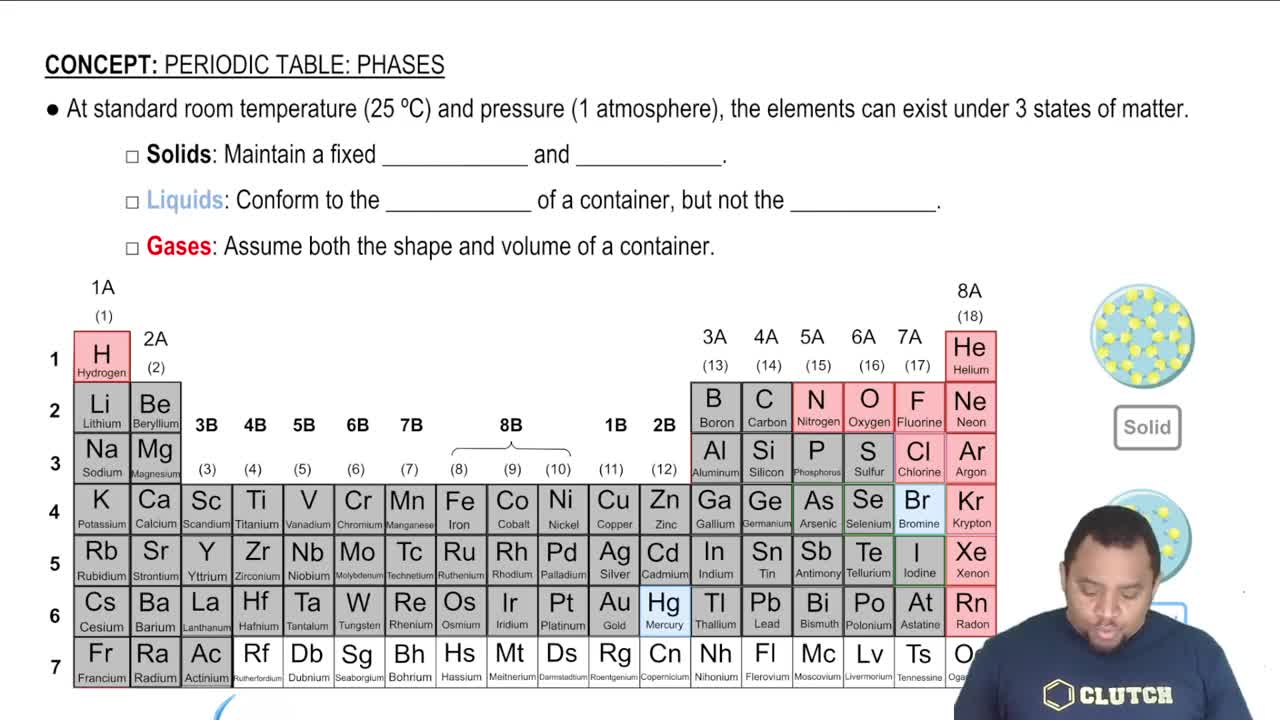
The periodic table is organized into groups (columns) that share similar chemical properties. For example, Group 1 contains alkali metals, which are highly reactive and typically found in nature as compounds rather than in pure form. Group 17 contains halogens, known for their reactivity and tendency to form salts with metals. Understanding these group characteristics is essential for identifying elements and their behaviors.
Elements can be classified based on their ability to conduct electricity. Metals, typically found on the left side of the periodic table, are good conductors, while nonmetals, located on the right, are generally poor conductors. This distinction is crucial for evaluating the properties of elements, especially when determining their classifications as metals, nonmetals, or metalloids.
Elements can exist in different physical states at room temperature: solid, liquid, or gas. Most metals are solid at room temperature, while nonmetals can be gases (like oxygen) or solids (like sulfur). Understanding the physical state of an element helps in predicting its behavior and interactions, which is vital for answering questions about their properties and classifications.