Which is more acidic? (a) Cr2O3 or CrO3 (b) N2O5 or N2O3 (c) SO2 or SO3
Verified step by step guidance
1
Step 1: Understand the concept of acidity in oxides. Generally, oxides of nonmetals tend to be acidic, and the acidity increases with the oxidation state of the central atom.
Step 2: For part (a), compare Cr2O3 and CrO3. Determine the oxidation states of chromium in each compound. Cr2O3 has chromium in a +3 oxidation state, while CrO3 has chromium in a +6 oxidation state.
Step 3: For part (b), compare N2O5 and N2O3. Determine the oxidation states of nitrogen in each compound. N2O5 has nitrogen in a +5 oxidation state, while N2O3 has nitrogen in a +3 oxidation state.
Step 4: For part (c), compare SO2 and SO3. Determine the oxidation states of sulfur in each compound. SO2 has sulfur in a +4 oxidation state, while SO3 has sulfur in a +6 oxidation state.
Step 5: Conclude that the compound with the higher oxidation state of the central atom is generally more acidic. Therefore, CrO3 is more acidic than Cr2O3, N2O5 is more acidic than N2O3, and SO3 is more acidic than SO2.
Key Concepts
Here are the essential concepts you must grasp in order to answer the question correctly.
Acidity and pH
Acidity refers to the ability of a substance to donate protons (H+) in a solution, which is quantitatively measured by pH. A lower pH indicates a higher concentration of hydrogen ions, thus a stronger acid. Understanding the pH scale is essential for comparing the acidity of different compounds.
The oxidation state of an element in a compound can influence its acid-base behavior. Generally, higher oxidation states in nonmetals lead to stronger acids due to increased electronegativity, which stabilizes the negative charge of the conjugate base formed after proton donation. This concept is crucial for evaluating the acidity of oxides.
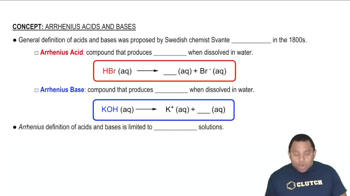
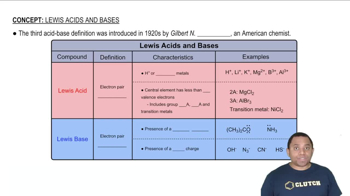
Lewis acids are defined as electron pair acceptors, while Lewis bases are electron pair donors. This broader definition of acidity allows for the classification of compounds that may not fit traditional definitions. Understanding this concept helps in analyzing the reactivity and acidity of various oxides in the question.


 Verified step by step guidance
 02:39
02:39