
The concentration of the Sn2+ solution used in Problem 4.130 can be found by letting it react with a known amount of Fe2+. What is the molar concentration of an Sn2+ solution if 23.84 mL is required for complete reaction with 1.4855 g of Fe2O3?
Verified step by step guidance
1
Identify the balanced chemical equation for the reaction between Sn^{2+} and Fe_2O_3. The reaction involves the reduction of Fe^{3+} to Fe^{2+} and the oxidation of Sn^{2+} to Sn^{4+}.
Calculate the moles of Fe_2O_3 using its molar mass. The molar mass of Fe_2O_3 is approximately 159.69 g/mol.
Determine the moles of Fe^{3+} ions produced from Fe_2O_3. Since each mole of Fe_2O_3 produces 2 moles of Fe^{3+}, multiply the moles of Fe_2O_3 by 2.
Use the stoichiometry of the balanced equation to find the moles of Sn^{2+} that reacted. The stoichiometry will tell you the mole ratio between Sn^{2+} and Fe^{3+}.
Calculate the molar concentration of the Sn^{2+} solution by dividing the moles of Sn^{2+} by the volume of the Sn^{2+} solution in liters (23.84 mL = 0.02384 L).
Verified video answer for a similar problem:
This video solution was recommended by our tutors as helpful for the problem above.
Video duration:
3m
Play a video:
Was this helpful?
Key Concepts
Here are the essential concepts you must grasp in order to answer the question correctly.
Stoichiometry
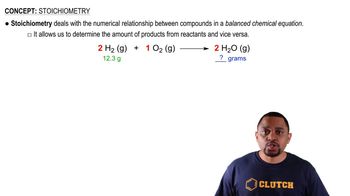
Stoichiometry is the branch of chemistry that deals with the quantitative relationships between the reactants and products in a chemical reaction. It allows us to calculate the amounts of substances consumed and produced in a reaction based on balanced chemical equations. Understanding stoichiometry is essential for determining the molar concentration of solutions when given mass and volume data.
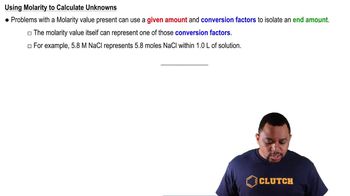
Molarity is a measure of concentration defined as the number of moles of solute per liter of solution. It is expressed in units of moles per liter (mol/L). To find the molarity of the Sn2+ solution, one must convert the mass of Fe2O3 into moles and relate it to the volume of the Sn2+ solution used in the reaction, using stoichiometric coefficients from the balanced equation.
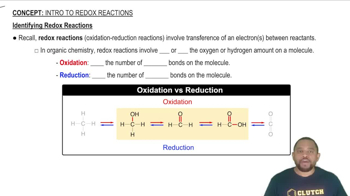
Redox reactions involve the transfer of electrons between two species, resulting in changes in oxidation states. In this context, the reaction between Sn2+ and Fe2O3 involves the reduction of Sn2+ and the oxidation of Fe3+. Understanding the principles of redox chemistry is crucial for determining how the reactants interact and for calculating the molar concentration of the Sn2+ solution based on the complete reaction with Fe2O3.