Write a molecular equation for the precipitation reaction that occurs (if any) when each pair of aqueous solutions is mixed. If no reaction occurs, write 'NO REACTION.' a. potassium carbonate and lead(II) nitrate
Ch.5 - Introduction to Solutions and Aqueous Solutions

Chapter 5, Problem 55b
Write balanced complete ionic and net ionic equations for each reaction. CaS(aq) + CuCl2(aq) → CuS(s) + CaCl2(aq)
Verified step by step guidance1
Identify the states of matter for each compound: CaS(aq), CuCl2(aq), CuS(s), and CaCl2(aq).
Write the balanced molecular equation: CaS(aq) + CuCl2(aq) → CuS(s) + CaCl2(aq).
Write the complete ionic equation by separating all aqueous compounds into their ions: Ca^{2+}(aq) + S^{2-}(aq) + Cu^{2+}(aq) + 2Cl^{-}(aq) → CuS(s) + Ca^{2+}(aq) + 2Cl^{-}(aq).
Identify and cancel the spectator ions that appear on both sides of the complete ionic equation: Ca^{2+}(aq) and 2Cl^{-}(aq).
Write the net ionic equation by including only the ions and compounds that participate in the reaction: Cu^{2+}(aq) + S^{2-}(aq) → CuS(s).
Key Concepts
Here are the essential concepts you must grasp in order to answer the question correctly.
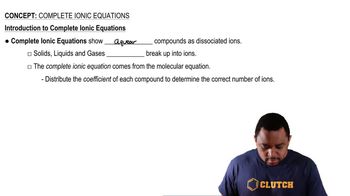
Complete Ionic Equation
A complete ionic equation represents all the ions present in a solution during a chemical reaction. It shows the reactants and products in their ionic forms, highlighting the dissociation of soluble ionic compounds. This equation is essential for understanding how ions interact in solution and sets the stage for identifying the net ionic equation.
Recommended video:
Guided course
Complete Ionic Equations
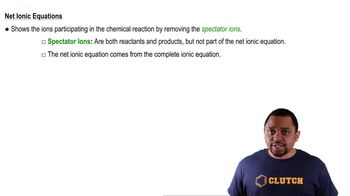
Net Ionic Equation
The net ionic equation simplifies the complete ionic equation by removing spectator ions—ions that do not participate in the actual chemical reaction. It focuses solely on the ions and molecules that undergo a change, providing a clearer picture of the chemical process. This equation is crucial for understanding the essence of the reaction and the formation of precipitates or other products.
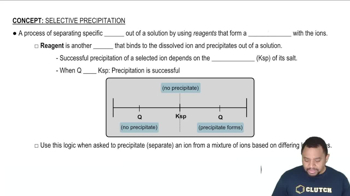
Precipitation Reaction
A precipitation reaction occurs when two aqueous solutions react to form an insoluble solid, known as a precipitate. This process is driven by the formation of a compound that cannot remain dissolved in the solution. Recognizing the conditions under which a precipitate forms is vital for predicting the products of a reaction and writing the corresponding ionic equations.
Recommended video:
Guided course
Selective Precipitation
Related Practice
Textbook Question
1107
views
Textbook Question
Write balanced complete ionic and net ionic equations for each reaction.
a. K2SO4(aq) + CaI2(aq) → CaSO4(s) + KI(aq)
b. NH4Cl(aq) + NaOH(aq) → H2O(l) + NH3(g) + NaCl(aq)
c. AgNO3(aq) + NaCl(aq) → AgCl(s) + NaNO3(aq)
860
views
Textbook Question
Write a molecular equation for the precipitation reaction that occurs (if any) when each pair of aqueous solutions is mixed. If no reaction occurs, write 'NO REACTION.' c. copper(II) nitrate and magnesium sulfide
1654
views
Textbook Question
Write balanced complete ionic and net ionic equations for each reaction.
c. NaOH(aq) + HC2H3O2(aq) → H2O(l ) + NaC2H3O2(aq)
d. Na3PO4(aq) + NiCl2(aq) → Ni3(PO4)2(s) + NaCl(aq)
898
views
Textbook Question
Write balanced complete ionic and net ionic equations for each reaction. d. Na3PO4(aq) + NiCl2(aq) → Ni3(PO4)2(s) + NaCl(aq)
8
views