Diagram the mechanism by which CRISPR–Cas functions in the immune system of bacteria and archaea.
Table of contents
- 1. Introduction to Genetics51m
- 2. Mendel's Laws of Inheritance3h 37m
- 3. Extensions to Mendelian Inheritance2h 41m
- 4. Genetic Mapping and Linkage2h 28m
- 5. Genetics of Bacteria and Viruses1h 21m
- 6. Chromosomal Variation1h 48m
- 7. DNA and Chromosome Structure56m
- 8. DNA Replication1h 10m
- 9. Mitosis and Meiosis1h 34m
- 10. Transcription1h 0m
- 11. Translation58m
- 12. Gene Regulation in Prokaryotes1h 19m
- 13. Gene Regulation in Eukaryotes44m
- 14. Genetic Control of Development44m
- 15. Genomes and Genomics1h 50m
- 16. Transposable Elements47m
- 17. Mutation, Repair, and Recombination1h 6m
- 18. Molecular Genetic Tools19m
- 19. Cancer Genetics29m
- 20. Quantitative Genetics1h 26m
- 21. Population Genetics50m
- 22. Evolutionary Genetics29m
15. Genomes and Genomics
Genomics and Human Medicine
Problem 11
Textbook Question
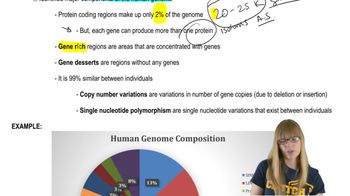
Describe the human genome in terms of genome size, the percentage of the genome that codes for proteins, how much is composed of repetitive sequences, and how many genes it contains. Describe two other features of the human genome.
Verified step by step guidance1
Start by defining the human genome as the complete set of DNA, including all of its genes, present in a human cell.
Explain the genome size by stating the approximate number of base pairs it contains, which is about 3 billion base pairs.
Describe the percentage of the genome that codes for proteins, noting that only about 1-2% of the human genome consists of protein-coding sequences.
Discuss the composition of repetitive sequences, highlighting that a significant portion, roughly 50%, of the genome is made up of repetitive DNA elements such as transposons and satellite DNA.
Mention the approximate number of genes in the human genome, which is around 20,000 to 25,000, and then describe two additional features such as the presence of non-coding RNA genes and regulatory elements that control gene expression.
Verified video answer for a similar problem:This video solution was recommended by our tutors as helpful for the problem above
Video duration:
1mPlay a video:
Was this helpful?
Key Concepts
Here are the essential concepts you must grasp in order to answer the question correctly.
Human Genome Size and Gene Content
The human genome consists of approximately 3 billion base pairs of DNA, organized into 23 pairs of chromosomes. It contains about 20,000 to 25,000 protein-coding genes, which are segments of DNA that provide instructions for making proteins essential for cellular functions.
Recommended video:
Guided course
Human Genome Composition
Protein-Coding vs. Non-Coding DNA
Only about 1-2% of the human genome codes for proteins, while the vast majority is non-coding DNA. Non-coding regions include regulatory elements, introns, and sequences with unknown functions, highlighting the complexity beyond just protein-coding genes.
Recommended video:
Guided course
The Genetic Code
Repetitive Sequences and Other Genomic Features
Repetitive sequences make up roughly 50% of the human genome and include elements like transposons and satellite DNA. Other notable features include regulatory sequences that control gene expression and structural elements such as telomeres and centromeres that maintain chromosome integrity.
Recommended video:
Guided course
Sequencing Difficulties
Watch next
Master Human Genome Composition with a bite sized video explanation from Kylia
Start learningRelated Videos
Related Practice
Textbook Question
631
views
