Pearson+ LogoPearson+ Logo
Ch. 21 - Genomic Analysis
Klug - Concepts of Genetics  12th Edition
Klug12th EditionConcepts of Genetics ISBN: 9780135564776Not the one you use?Change textbook
Chapter 21, Problem 9

What functional information about a genome can be determined through applications of chromatin immunoprecipitation (ChIP)?

Verified step by step guidance
1
Understand the purpose of chromatin immunoprecipitation (ChIP): ChIP is a technique used to study protein-DNA interactions. It helps identify the specific locations on the genome where proteins, such as transcription factors or histones with specific modifications, bind to DNA.
Recognize the functional information ChIP provides: By identifying protein binding sites, ChIP can reveal regulatory regions of the genome, such as promoters, enhancers, or silencers, and provide insights into gene regulation mechanisms.
Learn about the role of histone modifications: ChIP can also be used to study histone modifications, which are chemical changes to histone proteins that affect chromatin structure and gene expression. This helps in understanding epigenetic regulation.
Understand the use of ChIP-seq: When combined with next-generation sequencing (ChIP-seq), the technique allows for genome-wide mapping of protein-DNA interactions, providing a comprehensive view of regulatory networks and chromatin states.
Interpret the results: The data obtained from ChIP experiments can be used to correlate protein binding or histone modifications with gene expression patterns, helping to determine the functional roles of specific genomic regions in cellular processes.

Verified video answer for a similar problem:

This video solution was recommended by our tutors as helpful for the problem above.
Video duration:
1m
Was this helpful?

Key Concepts

Here are the essential concepts you must grasp in order to answer the question correctly.

Chromatin Structure

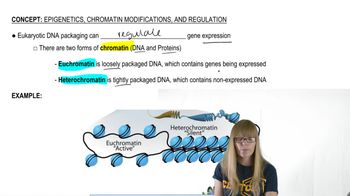
Chromatin is a complex of DNA and proteins that forms chromosomes within the nucleus of eukaryotic cells. Its structure can influence gene expression, as tightly packed chromatin (heterochromatin) is generally less accessible for transcription, while loosely packed chromatin (euchromatin) is more accessible. Understanding chromatin structure is essential for interpreting how genes are regulated and expressed.
Recommended video:

Chromatin Immunoprecipitation (ChIP)

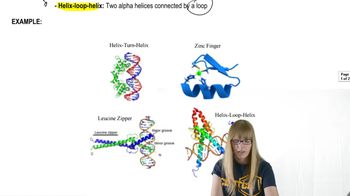
Chromatin immunoprecipitation (ChIP) is a technique used to investigate the interaction between proteins and DNA within the chromatin context. By using specific antibodies to isolate protein-DNA complexes, researchers can identify which genes are associated with particular proteins, such as transcription factors or histones, thereby providing insights into gene regulation and epigenetic modifications.
Recommended video:

Gene Regulation

Gene regulation refers to the mechanisms that control the expression of genes, determining when and how much of a gene product is made. This process is influenced by various factors, including transcription factors, chromatin structure, and epigenetic modifications. Understanding gene regulation is crucial for interpreting the functional information derived from ChIP assays, as it reveals how specific proteins modulate gene activity in response to cellular signals.
Recommended video:
Guided course
09:22
Review of Regulation