Write a short essay that contrasts the major differences between the organization of DNA in viruses and bacteria versus eukaryotes.
Table of contents
- 1. Introduction to Genetics51m
- 2. Mendel's Laws of Inheritance3h 37m
- 3. Extensions to Mendelian Inheritance2h 41m
- 4. Genetic Mapping and Linkage2h 28m
- 5. Genetics of Bacteria and Viruses1h 21m
- 6. Chromosomal Variation1h 48m
- 7. DNA and Chromosome Structure56m
- 8. DNA Replication1h 10m
- 9. Mitosis and Meiosis1h 34m
- 10. Transcription1h 0m
- 11. Translation58m
- 12. Gene Regulation in Prokaryotes1h 19m
- 13. Gene Regulation in Eukaryotes44m
- 14. Genetic Control of Development44m
- 15. Genomes and Genomics1h 50m
- 16. Transposable Elements47m
- 17. Mutation, Repair, and Recombination1h 6m
- 18. Molecular Genetic Tools19m
- 19. Cancer Genetics29m
- 20. Quantitative Genetics1h 26m
- 21. Population Genetics50m
- 22. Evolutionary Genetics29m
7. DNA and Chromosome Structure
Bacterial and Viral Chromosome Structure
Problem 24
Textbook Question
The following is a diagram of the general structure of the bacteriophage chromosome. Speculate on the mechanism by which it forms a closed ring upon infection of the host cell.

Verified step by step guidance1
Step 1: Identify the key features of the bacteriophage chromosome structure shown in the diagram, focusing on the double-stranded DNA region and the complementary single-stranded ends.
Step 2: Recognize that the complementary sequences at the ends of the linear DNA can base pair with each other, which is essential for forming a closed circular structure.
Step 3: Understand that upon infection, the single-stranded complementary ends can anneal through base pairing, bringing the two ends of the linear chromosome together.
Step 4: Consider the role of host or phage-encoded enzymes, such as DNA ligase, which can covalently join the sugar-phosphate backbones of the annealed ends, sealing the DNA into a closed circular ring.
Step 5: Summarize the mechanism as a process where complementary single-stranded ends hybridize to form a circular intermediate, followed by enzymatic ligation to create a stable closed ring chromosome inside the host cell.
Verified video answer for a similar problem:This video solution was recommended by our tutors as helpful for the problem above
Video duration:
1mPlay a video:
Was this helpful?
Key Concepts
Here are the essential concepts you must grasp in order to answer the question correctly.
Bacteriophage Chromosome Structure
Bacteriophage chromosomes often consist of double-stranded DNA with specific sequences that can interact to form unique structures. Understanding the arrangement of complementary sequences and double-stranded regions is essential to grasp how the DNA can circularize or form closed rings upon infection.
Recommended video:
Guided course
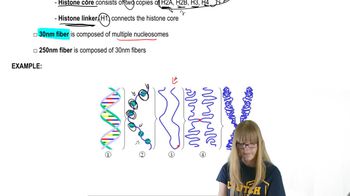
Chromosome Structure
DNA Complementarity and Base Pairing
DNA strands are complementary, meaning bases on one strand pair specifically with bases on the opposite strand (A with T, G with C). This complementarity allows single-stranded regions or sticky ends to anneal, facilitating the formation of circular DNA molecules through base pairing.
Recommended video:
Guided course
Complementation
Mechanism of DNA Circularization in Phages
Upon infection, linear phage DNA can circularize by annealing complementary single-stranded ends or through enzymatic ligation. This closed ring formation protects the DNA from degradation and is critical for replication and integration within the host.
Recommended video:
Guided course
Organelle DNA Characteristics
Watch next
Master Bacteria and Viral Chromosome Structure with a bite sized video explanation from Kylia
Start learningRelated Videos
Related Practice
Textbook Question
434
views