What is the chromosome theory of inheritance, and how is it related to Mendel's findings?
Verified step by step guidance
1
Understand that the chromosome theory of inheritance states that genes are located on chromosomes, which are the carriers of genetic information during reproduction.
Recall Mendel's findings, which showed that traits are inherited in discrete units (now called genes) and follow specific patterns such as segregation and independent assortment.
Connect Mendel's concept of hereditary units with chromosomes by recognizing that chromosomes behave in ways that explain Mendel's laws, such as segregating and assorting independently during meiosis.
Explain that the chromosome theory provided a physical basis for Mendel's abstract factors by identifying chromosomes as the structures that carry genes and undergo segregation and independent assortment.
Summarize that the chromosome theory of inheritance bridges Mendel's genetic principles with cellular processes, showing that the behavior of chromosomes during meiosis underlies the patterns of inheritance Mendel described.
Verified video answer for a similar problem:
This video solution was recommended by our tutors as helpful for the problem above
Video duration:
1m
Play a video:
Was this helpful?
Key Concepts
Here are the essential concepts you must grasp in order to answer the question correctly.
Chromosome Theory of Inheritance
This theory states that genes are located on chromosomes, which are the carriers of hereditary information. It explains how chromosomes segregate and assort independently during meiosis, leading to the inheritance patterns observed in offspring.
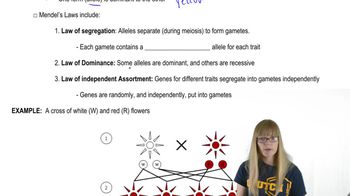
Mendel's laws, including the Law of Segregation and the Law of Independent Assortment, describe how traits are inherited through discrete units called genes. These laws were derived from his experiments with pea plants and form the foundation of classical genetics.
Relationship Between Chromosomes and Mendel's Genes
The chromosome theory connects Mendel's abstract 'factors' (genes) to physical structures (chromosomes). It shows that the behavior of chromosomes during meiosis explains Mendel's observed patterns of inheritance, providing a cellular basis for genetic transmission.