Three independently assorting STR markers (A, B, and C) are used to assess the paternity of a colt recently born to a quarter horse mare. Blood samples are drawn from the mare, her colt, and three possible male sires (S₁, S₂, and S₃). DNA at each marker locus is amplified by PCR, and a DNA electrophoresis gel is run for each marker. Amplified DNA bands are visualized in each gel by ethidium bromide staining. Gel results are shown below for each marker. Evaluate the data and determine if any of the potential sires can be excluded. Explain the basis of exclusion, if any, in each case.
Table of contents
- 1. Introduction to Genetics51m
- 2. Mendel's Laws of Inheritance3h 37m
- 3. Extensions to Mendelian Inheritance2h 41m
- 4. Genetic Mapping and Linkage2h 28m
- 5. Genetics of Bacteria and Viruses1h 21m
- 6. Chromosomal Variation1h 48m
- 7. DNA and Chromosome Structure56m
- 8. DNA Replication1h 10m
- 9. Mitosis and Meiosis1h 34m
- 10. Transcription1h 0m
- 11. Translation58m
- 12. Gene Regulation in Prokaryotes1h 19m
- 13. Gene Regulation in Eukaryotes44m
- 14. Genetic Control of Development44m
- 15. Genomes and Genomics1h 50m
- 16. Transposable Elements47m
- 17. Mutation, Repair, and Recombination1h 6m
- 18. Molecular Genetic Tools19m
- 19. Cancer Genetics29m
- 20. Quantitative Genetics1h 26m
- 21. Population Genetics50m
- 22. Evolutionary Genetics29m
18. Molecular Genetic Tools
Methods for Analyzing DNA
Problem 14
Textbook Question
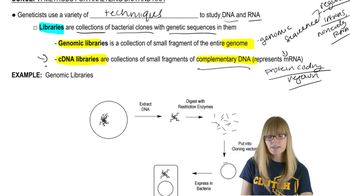
What advantages do cDNA libraries provide over genomic DNA libraries? Describe cloning applications where the use of a genomic library is necessary to provide information that a cDNA library cannot.
Verified step by step guidance1
Understand the nature of cDNA libraries: cDNA libraries are made from mRNA transcripts that have been reverse-transcribed into complementary DNA (cDNA). This means they represent only the expressed genes in a particular tissue or cell type at the time of RNA extraction, and they lack introns and non-coding regions.
Recognize the advantages of cDNA libraries: Since cDNA libraries contain only coding sequences (exons), they are useful for studying gene expression, producing recombinant proteins, and identifying coding sequences without introns, which simplifies cloning and expression in prokaryotic systems.
Understand the nature of genomic DNA libraries: Genomic libraries contain fragments of the entire genome, including coding regions, introns, regulatory sequences, and intergenic regions. They represent the complete genetic content of an organism.
Identify cloning applications requiring genomic libraries: When studying gene regulation, intron-exon structure, promoter regions, or non-coding DNA elements, a genomic library is necessary because cDNA libraries lack these sequences. Also, for organisms with alternative splicing or unknown gene structures, genomic libraries provide the full context.
Summarize the complementary uses: Use cDNA libraries to analyze expressed genes and produce proteins, and use genomic libraries to investigate gene structure, regulatory elements, and genomic organization that cDNA libraries cannot provide.
Verified video answer for a similar problem:This video solution was recommended by our tutors as helpful for the problem above
Video duration:
1mPlay a video:
Was this helpful?
Key Concepts
Here are the essential concepts you must grasp in order to answer the question correctly.
cDNA Libraries
cDNA libraries are collections of complementary DNA sequences synthesized from mRNA transcripts, representing only the expressed genes in a cell at a given time. They exclude non-coding regions like introns and regulatory sequences, making them useful for studying gene expression and producing protein-coding sequences.
Recommended video:
Guided course
Methods for Analyzing DNA and RNA
Genomic DNA Libraries
Genomic DNA libraries contain fragments of an organism's entire genome, including coding regions, introns, regulatory elements, and intergenic sequences. They provide a comprehensive representation of all genetic material, which is essential for studying gene structure, regulatory sequences, and non-expressed regions.
Recommended video:
Guided course
Genomic Variation
Applications Requiring Genomic Libraries
Genomic libraries are necessary when information about gene regulation, intron-exon structure, or non-coding DNA is required. They are crucial for cloning entire genes with regulatory elements, studying mutations in non-coding regions, or analyzing genome organization, which cDNA libraries cannot provide due to their focus on expressed sequences only.
Recommended video:
Guided course
Functional Genomics
Watch next
Master Methods for Analyzing DNA and RNA with a bite sized video explanation from Kylia
Start learningRelated Videos
Related Practice
Textbook Question
591
views