A 'wrongful birth' case was recently brought before a court in which a child with Smith–Lemli–Opitz syndrome was born to apparently healthy parents. This syndrome is characterized by a cluster of birth defects including cleft palate, and an array of problems with the reproductive and urinary organs. Originally considered by their physician as having a nongenetic basis, the parents decided to have another child, who was also born with Smith–Lemli–Opitz syndrome. In the role of a genetic counselor, instruct the court about what occurred, including the probability of the parents having two affected offspring, knowing that the disorder is inherited as a recessive trait.
Table of contents
- 1. Introduction to Genetics51m
- 2. Mendel's Laws of Inheritance3h 37m
- 3. Extensions to Mendelian Inheritance2h 41m
- 4. Genetic Mapping and Linkage2h 28m
- 5. Genetics of Bacteria and Viruses1h 21m
- 6. Chromosomal Variation1h 48m
- 7. DNA and Chromosome Structure56m
- 8. DNA Replication1h 10m
- 9. Mitosis and Meiosis1h 34m
- 10. Transcription1h 0m
- 11. Translation58m
- 12. Gene Regulation in Prokaryotes1h 19m
- 13. Gene Regulation in Eukaryotes44m
- 14. Genetic Control of Development44m
- 15. Genomes and Genomics1h 50m
- 16. Transposable Elements47m
- 17. Mutation, Repair, and Recombination1h 6m
- 18. Molecular Genetic Tools19m
- 19. Cancer Genetics29m
- 20. Quantitative Genetics1h 26m
- 21. Population Genetics50m
- 22. Evolutionary Genetics29m
2. Mendel's Laws of Inheritance
Pedigrees
Problem 30a
Textbook Question
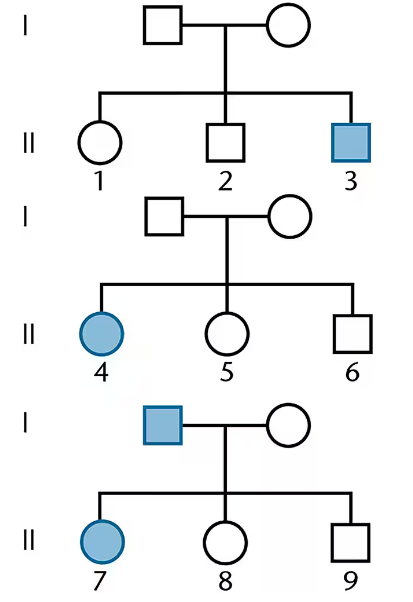
Consider the three pedigrees below, all involving a single human trait.

Which combination of conditions, if any, can be excluded? dominant and X-linked dominant and autosomal recessive and X-linked recessive and autosomal
Verified step by step guidance1
Step 1: Identify the pattern of affected individuals in each pedigree. Note the sex of affected individuals (squares for males, circles for females) and whether the trait appears in every generation or skips generations.
Step 2: For autosomal dominant traits, affected individuals usually appear in every generation and both males and females are equally likely to be affected. Check if this pattern fits any of the pedigrees.
Step 3: For X-linked dominant traits, affected males pass the trait to all daughters but no sons, and affected females can pass it to both sons and daughters. Look for affected females in every generation and affected males passing the trait to daughters.
Step 4: For autosomal recessive traits, the trait can skip generations, and affected individuals can have unaffected parents. Both males and females are equally affected. Check if the trait appears in siblings but not parents.
Step 5: For X-linked recessive traits, more males are affected than females, and affected males usually inherit the trait from carrier mothers. Affected males do not pass the trait to sons but can pass the allele to daughters who become carriers. Look for this pattern in the pedigrees.
Verified video answer for a similar problem:This video solution was recommended by our tutors as helpful for the problem above
Video duration:
3mPlay a video:
Was this helpful?
Key Concepts
Here are the essential concepts you must grasp in order to answer the question correctly.
Modes of Inheritance
Modes of inheritance describe how traits are passed from parents to offspring. Common types include autosomal dominant, autosomal recessive, X-linked dominant, and X-linked recessive. Each mode has distinct patterns in pedigrees, such as affected individuals in every generation for dominant traits or skipping generations for recessive traits.
Recommended video:
Guided course
Organelle Inheritance
Pedigree Analysis
Pedigree analysis involves studying family trees to track the inheritance of traits. Squares represent males, circles represent females, and shaded symbols indicate affected individuals. By examining affected and unaffected members across generations, one can infer the likely mode of inheritance.
Recommended video:
Guided course
Pedigree Flowchart
X-linked vs Autosomal Traits
X-linked traits are associated with genes on the X chromosome and often show different patterns between males and females, such as males being more frequently affected in X-linked recessive traits. Autosomal traits are located on non-sex chromosomes and typically affect males and females equally.
Recommended video:
Guided course
X-Inactivation
Related Videos
Related Practice
Textbook Question
463
views
