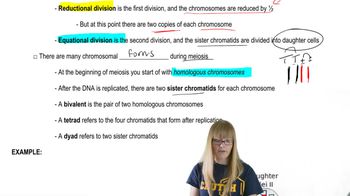
Contrast the genetic content and the origin of sister versus nonsister chromatids during their earliest appearance in prophase I of meiosis. How might the genetic content of these change by the time tetrads have aligned at the equatorial plate during metaphase I?
Table of contents
- 1. Introduction to Genetics51m
- 2. Mendel's Laws of Inheritance3h 37m
- 3. Extensions to Mendelian Inheritance2h 41m
- 4. Genetic Mapping and Linkage2h 28m
- 5. Genetics of Bacteria and Viruses1h 21m
- 6. Chromosomal Variation1h 48m
- 7. DNA and Chromosome Structure56m
- 8. DNA Replication1h 10m
- 9. Mitosis and Meiosis1h 34m
- 10. Transcription1h 0m
- 11. Translation58m
- 12. Gene Regulation in Prokaryotes1h 19m
- 13. Gene Regulation in Eukaryotes44m
- 14. Genetic Control of Development44m
- 15. Genomes and Genomics1h 50m
- 16. Transposable Elements47m
- 17. Mutation, Repair, and Recombination1h 6m
- 18. Molecular Genetic Tools19m
- 19. Cancer Genetics29m
- 20. Quantitative Genetics1h 26m
- 21. Population Genetics50m
- 22. Evolutionary Genetics29m
9. Mitosis and Meiosis
Meiosis
Problem 16
Textbook Question
Considering Problem 15, predict the number of different haploid cells that could be produced by meiosis if a fourth chromosome pair (W1 and W2) were added.
Verified step by step guidance1
Recall that the number of different haploid cells produced by meiosis depends on the number of chromosome pairs due to independent assortment. Each chromosome pair can segregate independently, creating genetic variation.
Identify the formula for the number of different haploid cells produced by independent assortment: \$2^n\(, where \)n$ is the number of chromosome pairs.
Determine the original number of chromosome pairs in Problem 15 (assume it was \(n\) pairs).
Add the new chromosome pair (W1 and W2) to the original number of pairs, resulting in \(n + 1\) pairs.
Apply the formula with the updated number of pairs: calculate \$2^{n+1}$ to find the new number of different haploid cells that could be produced.
Verified video answer for a similar problem:This video solution was recommended by our tutors as helpful for the problem above
Video duration:
1mPlay a video:
Was this helpful?
Key Concepts
Here are the essential concepts you must grasp in order to answer the question correctly.
Meiosis and Haploid Cell Formation
Meiosis is a type of cell division that reduces the chromosome number by half, producing haploid cells from diploid cells. During meiosis, homologous chromosomes separate, ensuring each haploid cell receives one chromosome from each pair, which is essential for sexual reproduction.
Recommended video:
Guided course
Meiosis Overview
Chromosome Pairs and Genetic Variation
Each chromosome pair consists of two homologous chromosomes, one from each parent. The number of different haploid cells produced depends on how these pairs assort independently during meiosis, leading to genetic variation through different combinations of chromosomes.
Recommended video:
Guided course
Genomic Variation
Independent Assortment and Calculation of Possible Haploid Combinations
Independent assortment refers to the random distribution of chromosome pairs into gametes during meiosis. The number of possible haploid combinations is calculated as 2^n, where n is the number of chromosome pairs. Adding a fourth pair increases the combinations exponentially.
Recommended video:
Guided course
Gamete Genetics and Independent Assortment
Related Videos
Related Practice
Textbook Question
710
views