Pearson+ LogoPearson+ Logo
Ch. 2 - Mitosis and Meiosis
Klug - Concepts of Genetics  12th Edition
Klug12th EditionConcepts of Genetics ISBN: 9780135564776Not the one you use?Change textbook
Chapter 2, Problem 14

Explain why meiosis leads to significant genetic variation while mitosis does not.

Verified step by step guidance
1
Mitosis and meiosis are both processes of cell division, but they serve different purposes and result in different outcomes.
Mitosis results in two genetically identical daughter cells, maintaining the same chromosome number as the parent cell. This process is primarily for growth and repair.
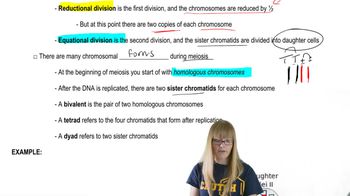
Meiosis, on the other hand, is a specialized form of cell division that reduces the chromosome number by half, producing four genetically diverse gametes (sperm or eggs).
Genetic variation in meiosis is introduced through two main mechanisms: crossing over and independent assortment.
Crossing over occurs during prophase I of meiosis, where homologous chromosomes exchange genetic material, while independent assortment refers to the random distribution of maternal and paternal chromosomes into gametes during metaphase I.

Verified video answer for a similar problem:

This video solution was recommended by our tutors as helpful for the problem above.
Video duration:
1m
Was this helpful?

Key Concepts

Here are the essential concepts you must grasp in order to answer the question correctly.

Meiosis

Meiosis is a specialized form of cell division that reduces the chromosome number by half, resulting in four genetically diverse gametes. It involves two rounds of division (meiosis I and II) and includes processes such as crossing over and independent assortment, which shuffle genetic material. This genetic recombination is crucial for sexual reproduction and contributes to the genetic diversity of offspring.
Recommended video:
Guided course
05:30
Meiosis Overview

Mitosis

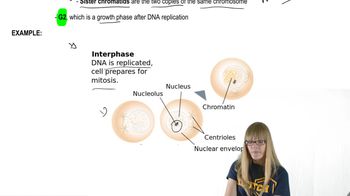
Mitosis is the process of cell division that results in two genetically identical daughter cells, maintaining the same chromosome number as the parent cell. It involves a single round of division and is primarily used for growth, repair, and asexual reproduction. Since mitosis does not involve recombination or reduction of chromosome number, it does not contribute to genetic variation.
Recommended video:
Guided course
09:46
Mitosis Steps

Genetic Variation

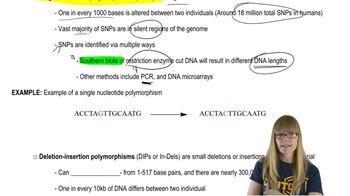
Genetic variation refers to the differences in DNA sequences among individuals within a population. It is essential for evolution and adaptation, as it provides the raw material for natural selection. In meiosis, mechanisms like crossing over and independent assortment create new combinations of alleles, leading to increased genetic diversity, whereas mitosis produces clones with no variation.
Recommended video:
Guided course
09:28
Genomic Variation
Related Practice
Textbook Question

Contrast the genetic content and the origin of sister versus nonsister chromatids during their earliest appearance in prophase I of meiosis. How might the genetic content of these change by the time tetrads have aligned at the equatorial plate during metaphase I?

748
views
Textbook Question

Given the end results of the two types of division, why is it necessary for homologs to pair during meiosis and not desirable for them to pair during mitosis?

465
views
Textbook Question

Contrast spermatogenesis and oogenesis. What is the significance of the formation of polar bodies?

624
views
Textbook Question

A diploid cell contains three pairs of homologous chromosomes designated C1 and C2, M1 and M2, and S1 and S2. No crossing over occurs. What combinations of chromosomes are possible in?

(a) daughter cells following mitosis

(b) cells undergoing the first meiotic metaphase

(c) haploid cells following both divisions of meiosis

1972
views
Textbook Question

Considering Problem 15, predict the number of different haploid cells that could be produced by meiosis if a fourth chromosome pair (W1 and W2) were added.

606
views
Textbook Question

During oogenesis in an animal species with a haploid number of 6, one dyad undergoes nondisjunction during meiosis II. Following the second meiotic division, this dyad ends up intact in the ovum. How many chromosomes are present in

(a) the mature ovum and

(b) the second polar body?

(c) Following fertilization by a normal sperm, what chromosome condition is created?

739
views