Which of the following is not a component of a nucleotide?
Table of contents
- 1. Introduction to Genetics51m
- 2. Mendel's Laws of Inheritance3h 37m
- 3. Extensions to Mendelian Inheritance2h 41m
- 4. Genetic Mapping and Linkage2h 28m
- 5. Genetics of Bacteria and Viruses1h 21m
- 6. Chromosomal Variation1h 48m
- 7. DNA and Chromosome Structure56m
- 8. DNA Replication1h 10m
- 9. Mitosis and Meiosis1h 34m
- 10. Transcription1h 0m
- 11. Translation58m
- 12. Gene Regulation in Prokaryotes1h 19m
- 13. Gene Regulation in Eukaryotes44m
- 14. Genetic Control of Development44m
- 15. Genomes and Genomics1h 50m
- 16. Transposable Elements47m
- 17. Mutation, Repair, and Recombination1h 6m
- 18. Molecular Genetic Tools19m
- 19. Cancer Genetics29m
- 20. Quantitative Genetics1h 26m
- 21. Population Genetics50m
- 22. Evolutionary Genetics29m
7. DNA and Chromosome Structure
DNA Structure
Problem 1c
Textbook Question
How was it determined that the structure of DNA is a double helix with the two strands held together by hydrogen bonds formed between complementary nitrogenous bases?
Verified step by step guidance1
Understand that the determination of DNA's double helix structure involved multiple experimental approaches, including X-ray crystallography, chemical analysis, and base pairing rules.
Recognize that Rosalind Franklin's X-ray diffraction images of DNA fibers provided critical evidence, showing a helical pattern and specific dimensions consistent with a double helix.
Learn that Chargaff's rules established that the amount of adenine (A) equals thymine (T), and the amount of guanine (G) equals cytosine (C), suggesting specific base pairing.
Combine the X-ray data with Chargaff's findings to hypothesize that DNA consists of two strands forming a helix, with complementary bases pairing via hydrogen bonds (A with T, G with C).
Understand that Watson and Crick built a physical model incorporating these data, demonstrating that hydrogen bonds between complementary bases stabilize the double helix structure.
Verified video answer for a similar problem:This video solution was recommended by our tutors as helpful for the problem above
Video duration:
2mPlay a video:
Was this helpful?
Key Concepts
Here are the essential concepts you must grasp in order to answer the question correctly.
X-ray Crystallography
X-ray crystallography is a technique used to determine the three-dimensional structure of molecules by analyzing the pattern of X-ray diffraction through crystallized samples. Rosalind Franklin's X-ray images of DNA provided critical evidence of a helical structure, showing a consistent repeating pattern indicative of a double helix.
Recommended video:
Guided course
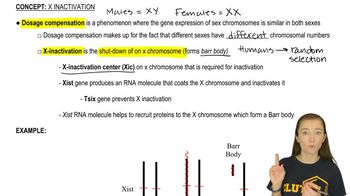
X-Inactivation
Complementary Base Pairing
Complementary base pairing refers to the specific hydrogen bonding between nitrogenous bases in DNA: adenine pairs with thymine via two hydrogen bonds, and guanine pairs with cytosine via three. This specificity explains how the two DNA strands align and are held together, ensuring accurate replication and stable structure.
Recommended video:
Guided course
Base Distortions
Watson and Crick’s Model of DNA
Watson and Crick proposed the double helix model of DNA based on experimental data, including Chargaff’s rules and Franklin’s X-ray images. Their model showed two antiparallel strands twisted into a helix, with bases paired in the interior via hydrogen bonds, explaining DNA’s structure and function in heredity.
Recommended video:
Guided course
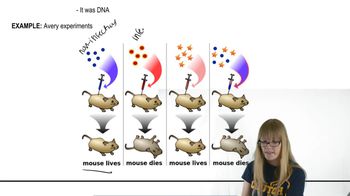
History and Experiments
Related Videos
Related Practice
Multiple Choice
1111
views
5
rank
