Which of the following chemical reactions provides the ribosome with the energy required to complete translation?
Table of contents
- 1. Introduction to Genetics51m
- 2. Mendel's Laws of Inheritance3h 37m
- 3. Extensions to Mendelian Inheritance2h 41m
- 4. Genetic Mapping and Linkage2h 28m
- 5. Genetics of Bacteria and Viruses1h 21m
- 6. Chromosomal Variation1h 48m
- 7. DNA and Chromosome Structure56m
- 8. DNA Replication1h 10m
- 9. Mitosis and Meiosis1h 34m
- 10. Transcription1h 0m
- 11. Translation58m
- 12. Gene Regulation in Prokaryotes1h 19m
- 13. Gene Regulation in Eukaryotes44m
- 14. Genetic Control of Development44m
- 15. Genomes and Genomics1h 50m
- 16. Transposable Elements47m
- 17. Mutation, Repair, and Recombination1h 6m
- 18. Molecular Genetic Tools19m
- 19. Cancer Genetics29m
- 20. Quantitative Genetics1h 26m
- 21. Population Genetics50m
- 22. Evolutionary Genetics29m
11. Translation
Translation
Problem 1b
Textbook Question
What experimental information verifies that certain codons in mRNA specify chain termination during translation?
Verified step by step guidance1
Understand that the question asks about experimental evidence showing that specific codons in mRNA act as stop signals during translation, causing the protein chain to terminate.
Recall that the key experimental approach involved using synthetic mRNAs with known sequences and observing the resulting polypeptides produced in cell-free translation systems.
One classic experiment used synthetic mRNAs composed of repeating codons (e.g., poly-U, poly-A) to determine which amino acids were incorporated, and then introduced mutations or specific codons suspected to be stop codons to see if translation halted.
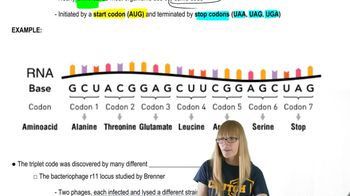
Analyze how researchers identified that certain codons (UAA, UAG, UGA) do not correspond to any amino acid but instead cause the ribosome to release the polypeptide chain, by observing truncated proteins or lack of amino acid incorporation beyond these codons.
Summarize that the experimental verification comes from comparing protein products synthesized from mRNAs with and without these codons, demonstrating that the presence of these codons leads to termination of translation.
Verified video answer for a similar problem:This video solution was recommended by our tutors as helpful for the problem above
Video duration:
1mPlay a video:
Was this helpful?
Key Concepts
Here are the essential concepts you must grasp in order to answer the question correctly.
The Genetic Code and Codons
The genetic code consists of triplet codons in mRNA, each specifying an amino acid or a stop signal during translation. Stop codons (UAA, UAG, UGA) do not code for amino acids but signal the termination of protein synthesis, ensuring the polypeptide chain is released at the correct point.
Recommended video:
Guided course
The Genetic Code
Experimental Evidence for Stop Codons
Experiments using synthetic mRNAs and in vitro translation systems demonstrated that specific codons cause translation to halt. For example, researchers observed that when stop codons were present, no corresponding amino acid was incorporated, and the polypeptide chain was released, confirming their role in termination.
Recommended video:
Guided course
Evolution
Role of Release Factors in Translation Termination
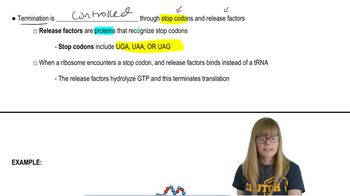
Release factors are proteins that recognize stop codons during translation and promote the release of the newly synthesized polypeptide from the ribosome. Their discovery and characterization provided biochemical proof that certain codons signal chain termination rather than coding for amino acids.
Recommended video:
Guided course
Translation Termination
Watch next
Master Translation initiation with a bite sized video explanation from Kylia
Start learningRelated Videos
Related Practice
Multiple Choice
599
views
3
rank