Pearson+ LogoPearson+ Logo
Ch. 14 - Translation and Proteins
Klug - Concepts of Genetics  12th Edition
Klug12th EditionConcepts of Genetics ISBN: 9780135564776Not the one you use?Change textbook
Chapter 14, Problem 1d

On what basis have we concluded that proteins are the end products of genetic expression?

Verified step by step guidance
1
Understand that genetic expression refers to the process by which information from a gene is used to synthesize a functional product, typically a protein.
Recall that experiments such as those by Beadle and Tatum showed that mutations in specific genes led to defects in specific enzymes, suggesting a direct link between genes and proteins ("one gene-one enzyme" hypothesis).
Consider the central dogma of molecular biology, which states that DNA is transcribed into RNA, and RNA is translated into protein, indicating proteins are the final products of gene expression.
Recognize that proteins perform most cellular functions and that changes in proteins correspond to changes in phenotype, reinforcing the idea that proteins are the functional end products.
Summarize that the conclusion is based on experimental evidence linking genes to enzymes/proteins, the molecular pathway of gene expression, and the functional role of proteins in cells.

Verified video answer for a similar problem:

This video solution was recommended by our tutors as helpful for the problem above.
Video duration:
1m
Was this helpful?

Key Concepts

Here are the essential concepts you must grasp in order to answer the question correctly.

Central Dogma of Molecular Biology

The central dogma describes the flow of genetic information from DNA to RNA to protein. It explains that genes encoded in DNA are transcribed into messenger RNA, which is then translated into proteins, establishing proteins as the final functional products of gene expression.
Recommended video:
Guided course
07:11
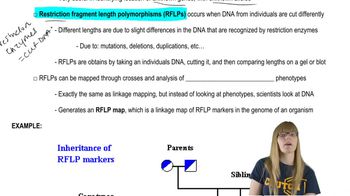
Mapping with Markers

Role of Proteins in Cellular Function

Proteins perform most cellular functions, including enzymatic activity, structural support, and signaling. Since genes code for proteins that determine phenotype, the presence and function of proteins confirm that they are the end products of genetic information.
Recommended video:

Experimental Evidence Linking Genes to Proteins

Experiments such as the one-gene-one-enzyme hypothesis and studies on mutations show that changes in genes affect specific proteins and their functions. This evidence supports the conclusion that proteins are the direct products of gene expression.
Recommended video:
Guided course
07:56
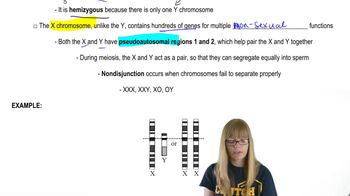
Sex-Linked Genes