Pearson+ LogoPearson+ Logo
Ch. 14 - Translation and Proteins
Klug - Concepts of Genetics  12th Edition
Klug12th EditionConcepts of Genetics ISBN: 9780135564776Not the one you use?Change textbook
Chapter 14, Problem 1e

How do we know that the structure of a protein is intimately related to the function of that protein?

Verified step by step guidance
1
Understand the relationship between protein structure and function: Proteins are composed of amino acids that fold into specific three-dimensional structures. This structure determines how the protein interacts with other molecules, which is critical for its function.
Examine experimental evidence: Researchers have shown that mutations in the DNA sequence can lead to changes in the amino acid sequence of a protein, which can alter its structure and impair its function. For example, in sickle cell anemia, a single amino acid substitution in hemoglobin changes its structure and reduces its ability to carry oxygen.
Consider the role of denaturation: Proteins lose their functional shape when exposed to extreme conditions (e.g., high temperature or pH changes). This demonstrates that the specific folding of a protein is essential for its activity.
Analyze examples of structure-function relationships: Enzymes, for instance, have active sites that are specifically shaped to bind to their substrates. Altering the shape of the active site through mutation or denaturation disrupts the enzyme's ability to catalyze reactions.
Review the concept of protein domains: Proteins often have distinct structural regions (domains) that are associated with specific functions. The modular nature of these domains further illustrates how structure is tied to function.

Verified video answer for a similar problem:

This video solution was recommended by our tutors as helpful for the problem above.
Video duration:
1m
Was this helpful?

Key Concepts

Here are the essential concepts you must grasp in order to answer the question correctly.

Protein Structure

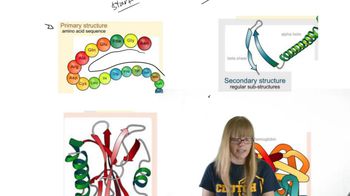
Protein structure refers to the specific three-dimensional arrangement of amino acids in a protein, which is categorized into four levels: primary, secondary, tertiary, and quaternary. Each level of structure contributes to the overall shape and stability of the protein, which is crucial for its function. For example, the folding of a protein into its functional shape allows it to interact with other molecules effectively.
Recommended video:

Structure-Function Relationship

The structure-function relationship in proteins posits that the specific shape and arrangement of a protein's structure directly influence its biological activity. This means that even slight changes in structure can lead to significant alterations in function, as seen in enzymes where the active site must be precisely shaped to bind substrates. Understanding this relationship is key to grasping how proteins perform their roles in biological systems.
Recommended video:
Guided course
08:26
Functional Genomics

Experimental Methods in Protein Study

Various experimental methods, such as X-ray crystallography, NMR spectroscopy, and cryo-electron microscopy, are employed to determine protein structures. These techniques have provided insights into how proteins fold and function, allowing scientists to correlate specific structural features with their biological roles. This empirical evidence supports the idea that the structure of a protein is intimately linked to its function.
Recommended video: