Textbook Question
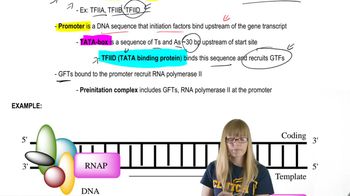
Answer these questions concerning promoters.
Eukaryotic promoters are more variable than bacterial promoters. Explain why.
567
views

 Sanders 3rd EditionCh. 8 - Molecular Biology of Transcription and RNA ProcessingProblem 3e
 Verified step by step guidance
 01:57
01:57
 09:16
09:16 08:26
08:26Answer these questions concerning promoters.
Eukaryotic promoters are more variable than bacterial promoters. Explain why.
The diagram below shows a DNA duplex. The template strand is identified, as is the location of the nucleotide.
Assume this region contains a gene transcribed in a bacterium. Identify the location of promoter consensus sequences and of the transcription termination sequence.
Answer these questions concerning promoters.
What is the common structure of a bacterial promoter with respect to consensus sequences?
Answer these questions concerning promoters.
What consensus sequences are detected in the mammalian β-globin gene promoter?
The diagram below shows a DNA duplex. The template strand is identified, as is the location of the nucleotide.
If this region is a eukaryotic gene transcribed by RNA polymerase III, where are the promoter consensus sequences located?
The diagram below shows a DNA duplex. The template strand is identified, as is the location of the nucleotide. consensus sequences.
Assume this region contains a gene transcribed to form mRNA in a eukaryote. Identify the location of the most common promoter.