Pearson+ LogoPearson+ Logo
Ch. 17 - Organelle Inheritance and the Evolution of Organelle Genomes
Sanders - Genetic Analysis: An Integrated Approach 3rd Edition
Sanders3rd EditionGenetic Analysis: An Integrated ApproachISBN: 9780135564172Not the one you use?Change textbook
Chapter 17, Problem 6

What are the differences between the universal code and that found in the mitochondria of some species? Given that some changes (UGA =stop→Trp) have occurred multiple independent times in evolution, can you think of any selective advantage to the mitochondrial code?

Verified step by step guidance
1
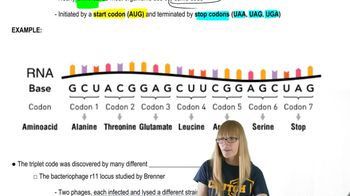
Understand the universal genetic code: The universal genetic code is a set of rules by which the nucleotide sequence of mRNA is translated into the amino acid sequence of proteins. It is nearly universal across all organisms, with codons (triplets of nucleotides) specifying particular amino acids or signaling stop codons.
Identify differences in the mitochondrial genetic code: Mitochondria have their own DNA and use a slightly different genetic code. For example, in human mitochondria, the codon UGA, which is a stop codon in the universal code, is translated as tryptophan (Trp). Similarly, other codons like AUA (isoleucine in the universal code) are translated as methionine (Met) in mitochondria.
Consider the evolutionary context: Changes in the mitochondrial genetic code, such as UGA = stop → Trp, have occurred independently in different lineages. This suggests that these changes may have been driven by selective pressures specific to mitochondrial function or environment.
Evaluate potential selective advantages: One possible advantage of the mitochondrial code changes could be optimization for mitochondrial protein synthesis. For example, reassigning a stop codon to an amino acid like tryptophan might allow for more efficient or specialized protein production in the mitochondria, which is critical for energy production and cellular metabolism.
Reflect on mitochondrial specialization: Mitochondria are highly specialized organelles with unique requirements for protein synthesis. The deviations in their genetic code may reflect adaptations to their specific roles in energy production, oxidative stress management, and other cellular processes, providing a selective advantage in certain evolutionary contexts.

Verified video answer for a similar problem:

This video solution was recommended by our tutors as helpful for the problem above.
Video duration:
2m
Was this helpful?

Key Concepts

Here are the essential concepts you must grasp in order to answer the question correctly.

Universal Genetic Code

The universal genetic code refers to the set of rules by which information encoded in genetic material (DNA or RNA) is translated into proteins. It consists of 64 codons, which correspond to 20 amino acids and serve as the foundation for protein synthesis across most organisms. This code is largely conserved, meaning that it is similar across diverse species, highlighting a common evolutionary origin.
Recommended video:
Guided course
11:43
The Genetic Code

Mitochondrial Genetic Code

The mitochondrial genetic code is a variation of the universal genetic code found in the mitochondria of eukaryotic cells. It differs in several codon assignments, such as UGA, which typically signals a stop codon in the universal code but can code for tryptophan in some mitochondrial codes. These variations can arise due to evolutionary adaptations specific to the energy-producing functions of mitochondria.
Recommended video:
Guided course
11:43
The Genetic Code

Selective Advantage

Selective advantage refers to a genetic trait that enhances an organism's ability to survive and reproduce in a specific environment. In the context of mitochondrial code variations, such as the reassignment of UGA, these changes may provide metabolic efficiencies or adaptations that improve energy production or stress responses, thereby offering a competitive edge in certain ecological niches.
Recommended video:
Guided course
05:54
Natural Selection