Genetics affects many aspects of our lives. Identify three ways genetics affects your life or the life of a family member or friend. The effects can be regularly encountered or can be one time only or occasional.
Table of contents
- 1. Introduction to Genetics51m
- 2. Mendel's Laws of Inheritance3h 37m
- 3. Extensions to Mendelian Inheritance2h 41m
- 4. Genetic Mapping and Linkage2h 28m
- 5. Genetics of Bacteria and Viruses1h 21m
- 6. Chromosomal Variation1h 48m
- 7. DNA and Chromosome Structure56m
- 8. DNA Replication1h 10m
- 9. Mitosis and Meiosis1h 34m
- 10. Transcription1h 0m
- 11. Translation58m
- 12. Gene Regulation in Prokaryotes1h 19m
- 13. Gene Regulation in Eukaryotes44m
- 14. Genetic Control of Development44m
- 15. Genomes and Genomics1h 50m
- 16. Transposable Elements47m
- 17. Mutation, Repair, and Recombination1h 6m
- 18. Molecular Genetic Tools19m
- 19. Cancer Genetics29m
- 20. Quantitative Genetics1h 26m
- 21. Population Genetics50m
- 22. Evolutionary Genetics29m
1. Introduction to Genetics
Fundamentals of Genetics
Problem 6
Textbook Question
Contrast chromosomes and genes.
Verified step by step guidance1
Start by defining what chromosomes are: chromosomes are long, thread-like structures made of DNA and proteins that carry genetic information in the form of genes. They are found in the nucleus of cells.
Next, define genes: genes are specific sequences of DNA located on chromosomes that code for proteins or functional RNA molecules, and they determine inherited traits.
Explain the relationship between chromosomes and genes: chromosomes serve as the physical carriers of genes, meaning that genes are segments or units located along the length of chromosomes.
Highlight the difference in scale and function: chromosomes are large structures containing many genes, while genes are smaller units that contain the instructions for making specific proteins.
Summarize by contrasting their roles: chromosomes organize and package genetic material, whereas genes are the functional units of heredity that encode traits.
Verified video answer for a similar problem:This video solution was recommended by our tutors as helpful for the problem above
Video duration:
2mPlay a video:
Was this helpful?
Key Concepts
Here are the essential concepts you must grasp in order to answer the question correctly.
Chromosomes
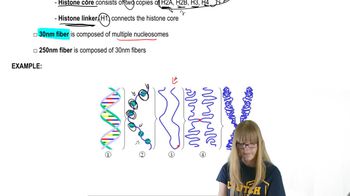
Chromosomes are long, thread-like structures made of DNA and proteins found in the nucleus of cells. They carry genetic information organized into genes and ensure DNA is accurately copied and distributed during cell division.
Recommended video:
Guided course
Chromosome Structure
Genes
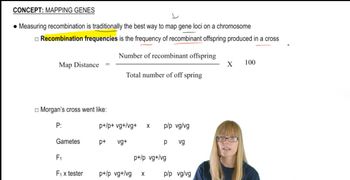
Genes are specific sequences of DNA that code for proteins or functional RNA molecules. They are the basic units of heredity and determine traits by directing the synthesis of molecules essential for cellular function.
Recommended video:
Guided course
Mapping Genes
Relationship between Chromosomes and Genes
Genes are segments located on chromosomes, meaning chromosomes serve as carriers of many genes. Understanding this relationship helps explain how genetic information is organized, inherited, and expressed within organisms.
Recommended video:
Guided course
Chromosome Structure
Related Videos
Related Practice
Textbook Question
499
views