Pearson+ LogoPearson+ Logo
Ch. 1 - Introduction to Genetics
Klug - Concepts of Genetics  12th Edition
Klug12th EditionConcepts of Genetics ISBN: 9780135564776Not the one you use?Change textbook
Chapter 1, Problem 7

How is genetic information encoded in a DNA molecule?

Verified step by step guidance
1
Understand that genetic information in a DNA molecule is encoded by the sequence of nitrogenous bases along the DNA strand. These bases are adenine (A), thymine (T), cytosine (C), and guanine (G).
Recognize that the DNA molecule is composed of two complementary strands forming a double helix, where bases pair specifically: adenine pairs with thymine (A-T) and cytosine pairs with guanine (C-G).
Learn that the order or sequence of these bases along one strand constitutes the genetic code, which determines the instructions for building proteins.
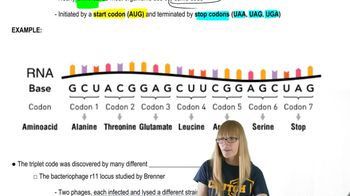
Know that groups of three bases, called codons, correspond to specific amino acids or signals during protein synthesis, thus translating the genetic code into functional molecules.
Summarize that the genetic information is stored in the linear sequence of bases, and this sequence is what cells read and interpret to produce proteins, which carry out various functions in living organisms.

Verified video answer for a similar problem:

This video solution was recommended by our tutors as helpful for the problem above.
Video duration:
1m
Was this helpful?

Key Concepts

Here are the essential concepts you must grasp in order to answer the question correctly.

Structure of DNA

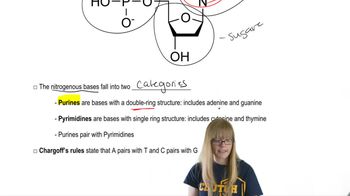
DNA is composed of two strands forming a double helix, with each strand made up of nucleotides. Each nucleotide contains a sugar, a phosphate group, and one of four nitrogenous bases: adenine, thymine, cytosine, or guanine. The sequence of these bases encodes genetic information.
Recommended video:
Guided course
06:25
DNA Structure

Base Pairing Rules

In DNA, bases pair specifically: adenine pairs with thymine, and cytosine pairs with guanine. This complementary base pairing ensures accurate replication and transcription of genetic information, maintaining the integrity of the genetic code.
Recommended video:
Guided course
03:49
Base Distortions

Genetic Code and Information Encoding

The order of nitrogenous bases along the DNA strand forms the genetic code, which specifies the sequence of amino acids in proteins. Groups of three bases, called codons, correspond to specific amino acids, enabling the translation of genetic information into functional molecules.
Recommended video:
Guided course
11:43
The Genetic Code