Pearson+ LogoPearson+ Logo
Ch. 1 - Introduction to Genetics
Klug - Concepts of Genetics  12th Edition
Klug12th EditionConcepts of Genetics ISBN: 9780135564776Not the one you use?Change textbook
Chapter 1, Problem 8

Describe the central dogma of molecular genetics and how it serves as the basis of modern genetics.

Verified step by step guidance
1
Begin by defining the central dogma of molecular genetics: it describes the flow of genetic information within a biological system, specifically from DNA to RNA to protein.
Explain that the process starts with transcription, where the DNA sequence of a gene is copied into messenger RNA (mRNA). This step involves the enzyme RNA polymerase synthesizing an RNA strand complementary to the DNA template.
Next, describe translation, where the mRNA sequence is decoded by ribosomes to assemble amino acids into a polypeptide chain, forming a protein. This step interprets the genetic code carried by the mRNA.
Highlight how this flow of information (DNA → RNA → Protein) underpins gene expression, determining how genetic information results in functional molecules that affect an organism's traits.
Conclude by discussing how the central dogma serves as the foundation of modern genetics by explaining how genetic information is stored, transmitted, and expressed, enabling advances in genetic engineering, molecular biology, and biotechnology.

Verified video answer for a similar problem:

This video solution was recommended by our tutors as helpful for the problem above.
Video duration:
1m
Was this helpful?

Key Concepts

Here are the essential concepts you must grasp in order to answer the question correctly.

Central Dogma of Molecular Genetics

The central dogma describes the flow of genetic information within a biological system: DNA is transcribed into RNA, which is then translated into proteins. This process explains how genetic instructions are expressed as functional molecules, forming the basis for cellular function and heredity.
Recommended video:
Guided course
03:45
Descriptive Genetics

Transcription and Translation

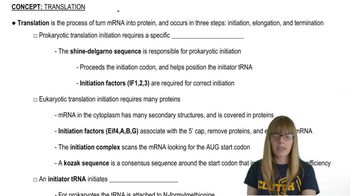
Transcription is the process where a segment of DNA is copied into messenger RNA (mRNA), which carries the genetic code to the ribosome. Translation is the subsequent decoding of mRNA into a specific sequence of amino acids, forming proteins essential for cellular activities.
Recommended video:
Guided course
07:58
Translation initiation

Role of Proteins in Genetics

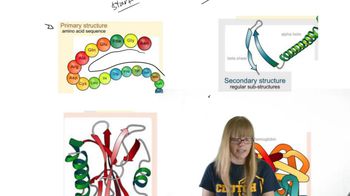
Proteins, produced through gene expression, perform diverse functions such as enzymes, structural components, and signaling molecules. Understanding protein synthesis links genetic information to phenotypic traits, highlighting the importance of the central dogma in modern genetics.
Recommended video: