Pearson+ LogoPearson+ Logo
Ch. 5 - Genetic Linkage and Mapping in Eukaryotes
Sanders - Genetic Analysis: An Integrated Approach 3rd Edition
Sanders3rd EditionGenetic Analysis: An Integrated ApproachISBN: 9780135564172Not the one you use?Change textbook
Chapter 5, Problem 9b

Genes A, B, C, D, and E are linked on a chromosome and occur in the order given.


Previous genetic linkage crosses have determined that recombination frequencies are 6% for genes A and B, 4% for genes B and C, 10% for genes C and D, and 11% for genes D and E. The sum of these frequencies between genes A and E is 31%. Why does the recombination distance between these genes as determined by adding the intervals between adjacent linked genes differ from the distance determined by the test cross?

Verified step by step guidance
1
Understand the problem: The question asks why the sum of recombination frequencies between adjacent genes (A to E) differs from the recombination frequency determined by the test cross. This involves understanding the concept of genetic linkage and recombination frequencies.
Recall that recombination frequencies are not strictly additive over long distances due to the phenomenon of double crossovers. Double crossovers can occur between genes, and these events are not detected in the recombination frequency, leading to an underestimation of the true genetic distance.
Examine the given recombination frequencies: The recombination frequencies between adjacent genes are 6% (A-B), 4% (B-C), 10% (C-D), and 11% (D-E). Adding these gives a total of 31%, which is the sum of the intervals. However, this does not account for double crossovers.
Understand the test cross result: The test cross measures the overall recombination frequency between genes A and E directly. This value is likely lower than the sum of the intervals because double crossovers between intermediate genes (e.g., B, C, D) are not detected in the test cross, reducing the apparent recombination frequency.
Conclude that the discrepancy arises because the sum of recombination frequencies assumes no double crossovers, while the test cross accounts for the actual recombination events, including the masking effect of double crossovers. This highlights the importance of considering double crossovers when interpreting genetic distances over long regions.

Verified video answer for a similar problem:

This video solution was recommended by our tutors as helpful for the problem above.
Video duration:
4m
Was this helpful?

Key Concepts

Here are the essential concepts you must grasp in order to answer the question correctly.

Genetic Linkage

Genetic linkage refers to the tendency of genes located close to each other on a chromosome to be inherited together during meiosis. This phenomenon occurs because linked genes are less likely to be separated by recombination events. Understanding linkage is crucial for interpreting recombination frequencies and constructing genetic maps.
Recommended video:
Guided course
07:33
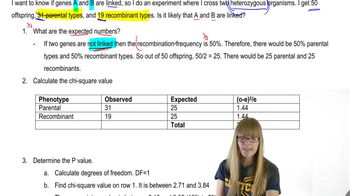
Chi Square and Linkage

Recombination Frequency

Recombination frequency is the measure of the likelihood that two genes will be separated during meiosis due to crossing over. It is expressed as a percentage, representing the proportion of offspring that exhibit recombinant phenotypes. This frequency is used to estimate the genetic distance between genes on a chromosome, with higher frequencies indicating greater distances.
Recommended video:
Guided course
03:51
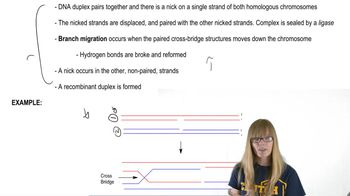
Recombination after Single Strand Breaks

Test Cross

A test cross involves breeding an individual with a homozygous recessive organism to determine the genotype of the former. This method helps reveal the presence of linked genes and their recombination frequencies. The results of a test cross can differ from calculated distances due to factors like interference, which can affect the actual occurrence of recombination events.
Recommended video:
Guided course
26:08
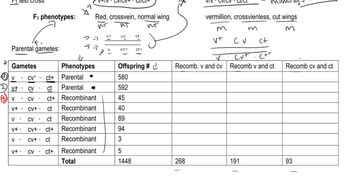
Trihybrid Cross
Related Practice
Textbook Question

Gene G recombines with gene T at a frequency of 7%, and gene G recombines with gene R at a frequency of 4%.


Draw two possible genetic maps for these three genes, and identify the recombination frequencies predicted for each map.

497
views
Textbook Question

Gene G recombines with gene T at a frequency of 7%, and gene G recombines with gene R at a frequency of 4%.


Assuming that organisms with any desired genotype are available, propose a genetic cross whose result could be used to determine which of the proposed genetic maps is correct.

539
views
Textbook Question

Genes A, B, C, D, and E are linked on a chromosome and occur in the order given.


The test cross Ae/aE x ae/ae  indicates the genes recombine with a frequency of 28%. If 1000 progeny are produced by this test cross, determine the number of progeny in each outcome class.

833
views
Textbook Question

Syntenic genes can assort independently. Explain this observation.

732
views
Textbook Question

Define linkage disequilibrium. What is the physical basis of linkage, and what causes linkage equilibrium? Explain how crossing over eliminates linkage disequilibrium.

795
views
Textbook Question

On the Drosophila X chromosome, the dominant allele y⁺ produces gray body color and the recessive allele y produces yellow body. This gene is linked to one controlling full eye shape by a dominant allele lz⁺ and lozenge eye shape with a recessive allele lz. These genes recombine with a frequency of approximately 28%. The Lz gene is linked to gene F controlling bristle form, where the dominant phenotype is long bristles and the recessive one is forked bristles. The Lz and F genes recombine with a frequency of approximately 32%.


Using any genotypes you choose, design two separate crosses, one to test recombination between genes Y and Lz and the second between genes Lz and F. Assume 1000 progeny are produced by each cross, and give the number of progeny in each outcome category. (In setting up your crosses, remember that Drosophila males do not undergo recombination.)

506
views