Which of the following markers is not useful for mapping genes?
Table of contents
- 1. Introduction to Genetics51m
- 2. Mendel's Laws of Inheritance3h 37m
- 3. Extensions to Mendelian Inheritance2h 41m
- 4. Genetic Mapping and Linkage2h 28m
- 5. Genetics of Bacteria and Viruses1h 21m
- 6. Chromosomal Variation1h 48m
- 7. DNA and Chromosome Structure56m
- 8. DNA Replication1h 10m
- 9. Mitosis and Meiosis1h 34m
- 10. Transcription1h 0m
- 11. Translation58m
- 12. Gene Regulation in Prokaryotes1h 19m
- 13. Gene Regulation in Eukaryotes44m
- 14. Genetic Control of Development44m
- 15. Genomes and Genomics1h 50m
- 16. Transposable Elements47m
- 17. Mutation, Repair, and Recombination1h 6m
- 18. Molecular Genetic Tools19m
- 19. Cancer Genetics29m
- 20. Quantitative Genetics1h 26m
- 21. Population Genetics50m
- 22. Evolutionary Genetics29m
4. Genetic Mapping and Linkage
Mapping with Markers
Problem 25
Textbook Question
DNA markers have greatly enhanced the mapping of genes in humans. What are DNA markers, and what advantage do they confer?
Verified step by step guidance1
Understand that DNA markers are specific sequences in the genome that can be easily identified and tracked across generations. They serve as landmarks on chromosomes.
Recognize that DNA markers are often polymorphic, meaning they vary between individuals, which makes them useful for distinguishing different genetic regions.
Learn that DNA markers do not necessarily have to be genes themselves; they can be any identifiable DNA sequence such as microsatellites or single nucleotide polymorphisms (SNPs).
Explore how DNA markers help in gene mapping by allowing researchers to track the inheritance of nearby genes through linkage analysis, even if the gene itself is not directly observable.
Identify the advantage of DNA markers as they enable more precise and efficient mapping of genes associated with traits or diseases, speeding up the discovery process and improving genetic studies.
Verified video answer for a similar problem:This video solution was recommended by our tutors as helpful for the problem above
Video duration:
2mPlay a video:
Was this helpful?
Key Concepts
Here are the essential concepts you must grasp in order to answer the question correctly.
DNA Markers
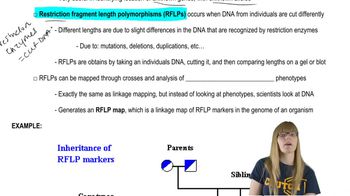
DNA markers are specific sequences in the genome that vary among individuals and can be easily identified. They serve as landmarks on chromosomes, helping researchers track the inheritance of nearby genes. Common types include microsatellites and single nucleotide polymorphisms (SNPs).
Recommended video:
Guided course
Mapping with Markers
Gene Mapping
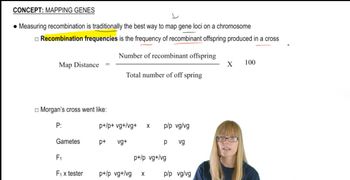
Gene mapping involves determining the location of genes on chromosomes. DNA markers facilitate this by acting as reference points, allowing scientists to associate particular markers with traits or diseases through linkage analysis.
Recommended video:
Guided course
Mapping Genes
Advantages of DNA Markers in Genetics
DNA markers provide a precise and efficient way to identify genetic variations linked to diseases or traits. They enable high-resolution mapping, reduce reliance on phenotypic traits, and accelerate the discovery of gene-disease associations.
Recommended video:
Guided course
Mapping with Markers
Related Videos
Related Practice
Multiple Choice
