Pearson+ LogoPearson+ Logo
Ch. 5 - Chromosome Mapping in Eukaryotes
Klug - Concepts of Genetics  12th Edition
Klug12th EditionConcepts of Genetics ISBN: 9780135564776Not the one you use?Change textbook
Chapter 5, Problem 26

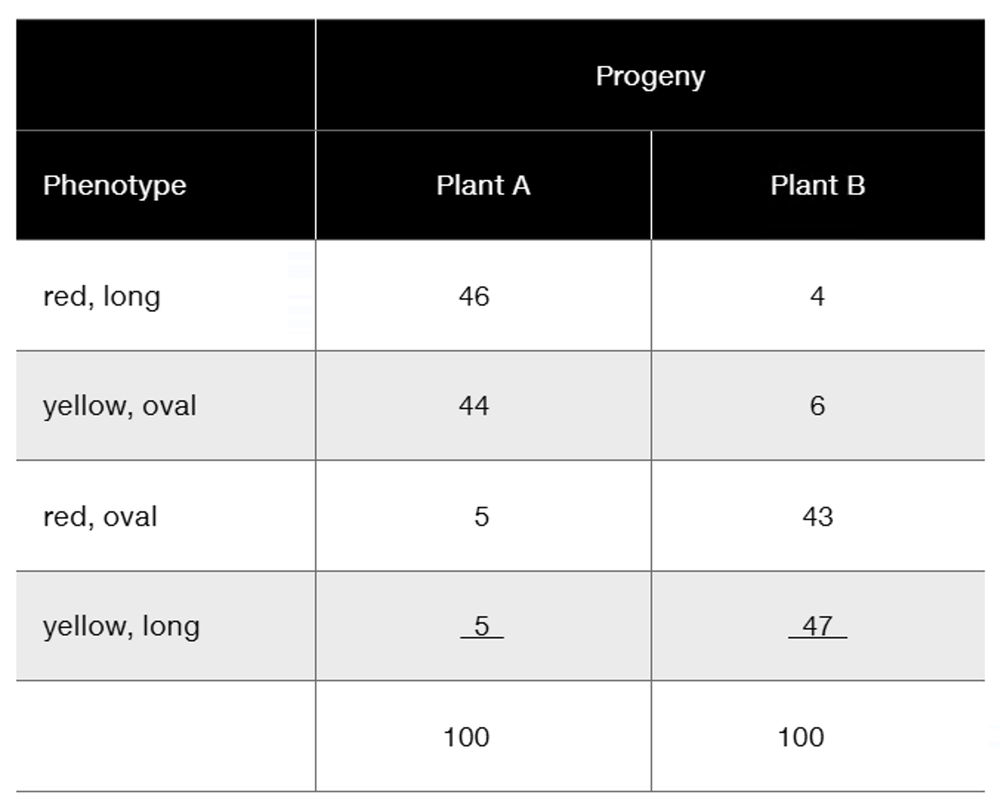
In a certain plant, fruit is either red or yellow, and fruit shape is either oval or long. Red and oval are the dominant traits. Two plants, both heterozygous for these traits, were testcrossed, with the following results.
Table showing progeny counts for two heterozygous plants testcrossed, with phenotypes red/long, yellow/oval, red/oval, and yellow/long.
Determine the location of the genes relative to one another and the genotypes of the two parental plants.

Verified step by step guidance
1
Step 1: Identify the parental genotypes and phenotypes. Both plants are heterozygous for fruit color (Red is dominant to Yellow) and fruit shape (Oval is dominant to Long). So, the parental genotypes are likely RrOo, where R = red, r = yellow, O = oval, and o = long.
Step 2: Analyze the progeny phenotypes and their counts from the testcross. The testcross involves crossing the heterozygous plants (RrOo) with homozygous recessive plants (rroo). The progeny phenotypes are red/long, yellow/oval, red/oval, and yellow/long with their respective counts for Plant A and Plant B.
Step 3: Determine which phenotypes represent parental (non-recombinant) and recombinant types. The most frequent phenotypes correspond to parental types, while the least frequent correspond to recombinants. For Plant A, red/long and yellow/oval are most frequent, so these are parental; red/oval and yellow/long are recombinant. For Plant B, red/oval and yellow/long are most frequent, so these are parental; red/long and yellow/oval are recombinant.
Step 4: Calculate the recombination frequency (RF) for each plant using the formula: \(\text{RF} = \frac{\text{Number of recombinant progeny}}{\text{Total progeny}} \times 100\). For Plant A, sum the recombinant progeny counts (red/oval + yellow/long) and divide by total progeny (100). Repeat for Plant B.
Step 5: Interpret the recombination frequency to determine gene linkage and relative gene location. A recombination frequency less than 50% indicates that the genes are linked and close on the same chromosome. The parental genotypes can be deduced based on which allele combinations are inherited together (coupling or repulsion phase).

Verified video answer for a similar problem:

This video solution was recommended by our tutors as helpful for the problem above.
Video duration:
55s
Was this helpful?

Key Concepts

Here are the essential concepts you must grasp in order to answer the question correctly.

Testcross and Its Purpose

A testcross involves crossing an individual with a homozygous recessive individual to determine the genotype of the former. It reveals whether the tested individual is heterozygous or homozygous dominant for specific traits by analyzing the phenotypes of the offspring. This method is essential for mapping gene linkage and recombination.
Recommended video:
Guided course
00:52
Purpose of X Inactivation

Gene Linkage and Recombination

Genes located close together on the same chromosome tend to be inherited together, a phenomenon called linkage. Recombination occurs when crossing over during meiosis exchanges genetic material between homologous chromosomes, producing new allele combinations. The frequency of recombinant offspring helps determine the physical distance between genes.
Recommended video:
Guided course
07:33
Chi Square and Linkage

Dominant and Recessive Traits and Phenotypic Ratios

Dominant traits mask the expression of recessive traits in heterozygotes. In this problem, red and oval are dominant, while yellow and long are recessive. Analyzing the phenotypic ratios of progeny from heterozygous parents helps infer parental genotypes and gene linkage, especially when deviations from expected Mendelian ratios occur.
Recommended video:
Guided course
13:40
Traits and Variance
Related Practice
Textbook Question

Based on our discussion of the potential inaccuracy of mapping, would you revise your answer to Problem 22? If so, how?

635
views
Textbook Question

Traditional gene mapping has been applied successfully to a variety of organisms including yeast, fungi, maize, and Drosophila. However, human gene mapping has only recently shared a similar spotlight. What factors have delayed the application of traditional gene-mapping techniques in humans?

542
views
Textbook Question

DNA markers have greatly enhanced the mapping of genes in humans. What are DNA markers, and what advantage do they confer?

771
views
Textbook Question

Two plants in a cross were each heterozygous for two gene pairs (Ab/aB) whose loci are linked and 25 mu apart. Assuming that crossing over occurs during the formation of both male and female gametes and that the A and B alleles are dominant, determine the phenotypic ratio of their offspring.

1225
views
Textbook Question

A number of human–mouse somatic cell hybrid clones were examined for the expression of specific human genes and the presence of human chromosomes. The results are summarized in the following table. Assign each gene to the chromosome on which it is located.

984
views
Textbook Question

A female of genotype

produces 100 meiotic tetrads. Of these, 68 show no crossover events. Of the remaining 32, 20 show a crossover between a and b, 10 show a crossover between b and c, and 2 show a double crossover between a and b and between b and c. Of the 400 gametes produced, how many of each of the 8 different genotypes will be produced? Assuming the order a–b–c and the allele arrangement previously shown, what is the map distance between these loci?

824
views