Pearson+ LogoPearson+ Logo
Ch. 5 - Chromosome Mapping in Eukaryotes
Klug - Concepts of Genetics  12th Edition
Klug12th EditionConcepts of Genetics ISBN: 9780135564776Not the one you use?Change textbook
Chapter 5, Problem 28

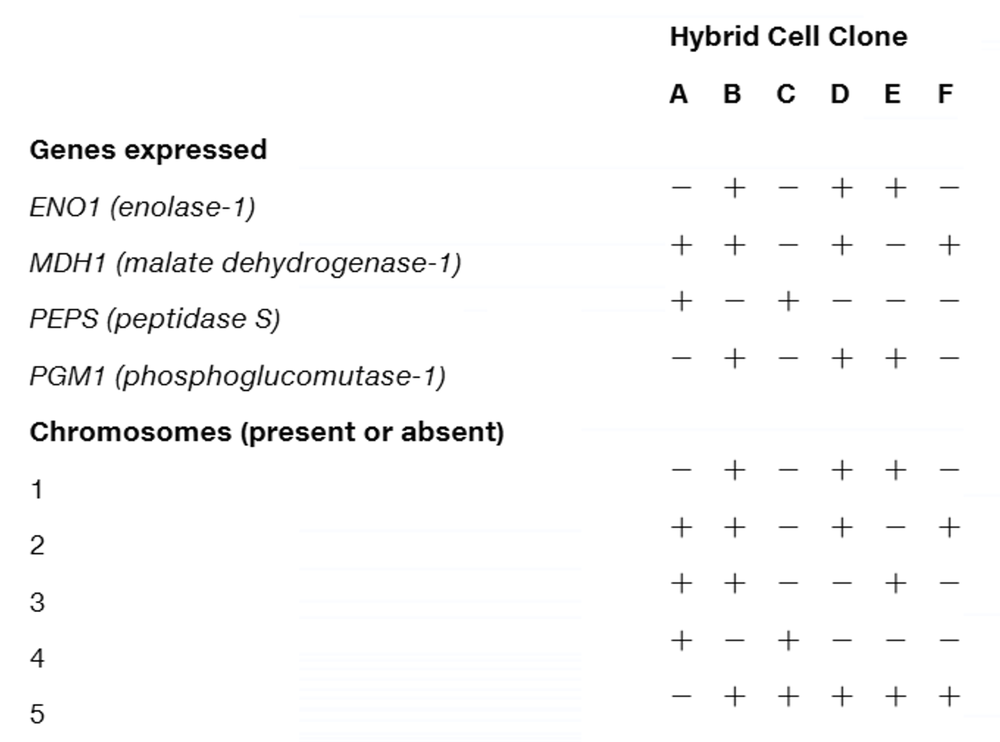
A number of human–mouse somatic cell hybrid clones were examined for the expression of specific human genes and the presence of human chromosomes. The results are summarized in the following table. Assign each gene to the chromosome on which it is located.
Table showing gene expression and chromosome presence across six hybrid cell clones, with plus and minus signs indicating presence or absence.

Verified step by step guidance
1
Step 1: Review the table provided in the problem, which lists the human genes expressed in each hybrid clone and the human chromosomes present in those clones. Identify the relationship between gene expression and chromosome presence.
Step 2: For each gene, determine which hybrid clones express the gene and note the human chromosomes present in those clones. This will help establish a correlation between gene expression and chromosome presence.
Step 3: Look for patterns where a specific human chromosome is consistently present in all clones expressing a particular gene. This suggests that the gene is located on that chromosome.
Step 4: Verify the assignment by checking if the gene is not expressed in clones where the corresponding chromosome is absent. This ensures the gene is correctly mapped to the chromosome.
Step 5: Assign each gene to the chromosome based on the analysis and document the results clearly, ensuring that each gene is matched to the correct chromosome.

Verified video answer for a similar problem:

This video solution was recommended by our tutors as helpful for the problem above.
Video duration:
37s
Was this helpful?

Key Concepts

Here are the essential concepts you must grasp in order to answer the question correctly.

Somatic Cell Hybridization

Somatic cell hybridization is a technique used to combine two different types of cells, typically from different species, to create a hybrid cell. This method allows researchers to study gene expression and chromosome behavior in a controlled environment. In the context of the question, human-mouse hybrids are used to identify the location of specific human genes on human chromosomes.
Recommended video:
Guided course
03:52
Cell-cell interactions

Gene Mapping

Gene mapping is the process of determining the specific locations of genes on chromosomes. This involves analyzing the genetic material of organisms to establish which genes are associated with which chromosomes. In the question, gene mapping is essential for assigning human genes to their respective chromosomes based on the hybrid clones' characteristics.
Recommended video:
Guided course
09:09
Mapping Genes

Chromosomal Analysis

Chromosomal analysis involves examining the structure and number of chromosomes in a cell. This can include techniques such as karyotyping or fluorescence in situ hybridization (FISH) to visualize chromosomes and identify specific genetic material. Understanding chromosomal analysis is crucial for interpreting the results of the hybrid clones and determining the presence of human chromosomes in the study.
Recommended video:
Guided course
02:48
Chi Square Analysis
Related Practice
Textbook Question

DNA markers have greatly enhanced the mapping of genes in humans. What are DNA markers, and what advantage do they confer?

771
views
Textbook Question

In a certain plant, fruit is either red or yellow, and fruit shape is either oval or long. Red and oval are the dominant traits. Two plants, both heterozygous for these traits, were testcrossed, with the following results.

Determine the location of the genes relative to one another and the genotypes of the two parental plants.

711
views
Textbook Question

Two plants in a cross were each heterozygous for two gene pairs (Ab/aB) whose loci are linked and 25 mu apart. Assuming that crossing over occurs during the formation of both male and female gametes and that the A and B alleles are dominant, determine the phenotypic ratio of their offspring.

1225
views
Textbook Question

A female of genotype

produces 100 meiotic tetrads. Of these, 68 show no crossover events. Of the remaining 32, 20 show a crossover between a and b, 10 show a crossover between b and c, and 2 show a double crossover between a and b and between b and c. Of the 400 gametes produced, how many of each of the 8 different genotypes will be produced? Assuming the order a–b–c and the allele arrangement previously shown, what is the map distance between these loci?

824
views
Textbook Question

In laboratory class, a genetics student was assigned to study an unknown mutation in Drosophila that had a whitish eye. He crossed females from his true-breeding mutant stock to wild-type (brick-red-eyed) males, recovering all wild-type F1 flies. In the F2 generation, the following offspring were recovered in the following proportions:

wild type: 5/8

bright red: 1/8

brown eye: 1/8

white eye: 1/8

The student was stumped until the instructor suggested that perhaps the whitish eye in the original stock was the result of homozygosity for a mutation causing brown eyes and a mutation causing bright red eyes, illustrating gene interaction. After much thought, the student was able to analyze the data, explain the results, and learn several things about the location of the two genes relative to one another. One key to his understanding was that crossing over occurs in Drosophila females but not in males. Based on his analysis, what did the student learn about the two genes?

554
views
Textbook Question

Drosophila melanogaster has one pair of sex chromosomes (XX or XY) and three pairs of autosomes, referred to as chromosomes II, III, and IV. A genetics student discovered a male fly with very short (sh) legs. Using this male, the student was able to establish a pure breeding stock of this mutant and found that it was recessive. She then incorporated the mutant into a stock containing the recessive gene black (b, body color located on chromosome II) and the recessive gene pink (p, eye color located on chromosome III). A female from the homozygous black, pink, short stock was then mated to a wild-type male. The F1 males of this cross were all wild type and were then backcrossed to the homozygous b, p, sh females. The F2 results appeared as shown in the following table. No other phenotypes were observed.

Based on these results, the student was able to assign short to a linkage group (a chromosome). Which one was it? Include your step-by-step reasoning.

3300
views