Ch. 5 - Chromosome Mapping in Eukaryotes
Klug - Concepts of Genetics  12th Edition
Klug12th EditionConcepts of Genetics ISBN: 9780135564776Not the one you use?Change textbook
Chapter 5, Problem 23

Based on our discussion of the potential inaccuracy of mapping, would you revise your answer to Problem 22? If so, how?

Verified step by step guidance
1
Step 1: Review the original answer to Problem 22 carefully, noting the genetic map distances and recombination frequencies that were calculated or inferred.
Step 2: Understand the concept of mapping inaccuracies, which often arise due to factors like interference, double crossovers, or limitations in detecting recombination events, as discussed in Figure 5.12.
Step 3: Consider how these inaccuracies might affect the original map distances—specifically, whether the distances might be underestimated or overestimated due to undetected double crossovers or interference.
Step 4: Adjust the original calculations by incorporating corrections for interference or by using more accurate mapping functions (such as the Kosambi or Haldane mapping functions) that account for crossover interference.
Step 5: Revise your answer by explaining how the corrected map distances or recombination frequencies differ from the original ones, and describe the biological implications of these adjustments on the genetic map.

Verified video answer for a similar problem:

This video solution was recommended by our tutors as helpful for the problem above.
Video duration:
1m
Was this helpful?

Key Concepts

Here are the essential concepts you must grasp in order to answer the question correctly.

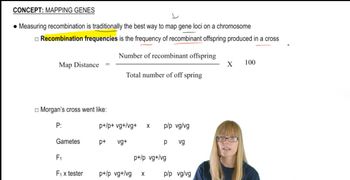
Genetic Mapping and Recombination Frequency

Genetic mapping estimates the relative positions of genes on a chromosome based on recombination frequencies. The frequency of crossover events between genes reflects their physical distance, with closer genes recombining less often. Understanding this helps interpret map distances and their potential inaccuracies.
Recommended video:
Guided course
09:09
Mapping Genes

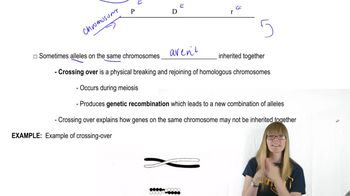
Limitations and Inaccuracies in Genetic Maps

Genetic maps can be inaccurate due to factors like interference, multiple crossovers, and limited sample sizes. These factors can cause underestimation or overestimation of distances between genes, leading to revisions in gene order or distance estimates.
Recommended video:
Guided course
11:11
Mapping Overview

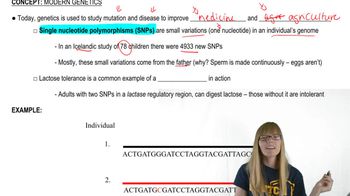
Interpreting and Revising Genetic Data

Revising answers based on new data or recognized inaccuracies involves critical analysis of mapping results. This includes reassessing gene order, distances, and considering alternative explanations or additional experiments to improve map accuracy.
Recommended video:
Guided course
09:03
Modern Genetics
Related Practice
Textbook Question

An organism of the genotype AaBbCc was testcrossed to a triply recessive organism (aabbcc). The genotypes of the progeny are presented in the following table.

If these three genes were all assorting independently, how many genotypic and phenotypic classes would result in the offspring, and in what proportion, assuming simple dominance and recessiveness in each gene pair?

930
views
Textbook Question

An organism of the genotype AaBbCc was testcrossed to a triply recessive organism (aabbcc). The genotypes of the progeny are presented in the following table.

Answer part (a) again, assuming the three genes are so tightly linked on a single chromosome that no crossover gametes were recovered in the sample of offspring.

1296
views
Textbook Question

An organism of the genotype AaBbCc was testcrossed to a triply recessive organism (aabbcc). The genotypes of the progeny are presented in the following table.

What can you conclude from the actual data about the location of the three genes in relation to one another?

919
views
Textbook Question

Traditional gene mapping has been applied successfully to a variety of organisms including yeast, fungi, maize, and Drosophila. However, human gene mapping has only recently shared a similar spotlight. What factors have delayed the application of traditional gene-mapping techniques in humans?

527
views
Textbook Question

DNA markers have greatly enhanced the mapping of genes in humans. What are DNA markers, and what advantage do they confer?

736
views
Textbook Question

In a certain plant, fruit is either red or yellow, and fruit shape is either oval or long. Red and oval are the dominant traits. Two plants, both heterozygous for these traits, were testcrossed, with the following results.

Determine the location of the genes relative to one another and the genotypes of the two parental plants.

694
views