True or False:Aneuploids are more abnormal that polyploids
Table of contents
- 1. Introduction to Genetics51m
- 2. Mendel's Laws of Inheritance3h 37m
- 3. Extensions to Mendelian Inheritance2h 41m
- 4. Genetic Mapping and Linkage2h 28m
- 5. Genetics of Bacteria and Viruses1h 21m
- 6. Chromosomal Variation1h 48m
- 7. DNA and Chromosome Structure56m
- 8. DNA Replication1h 10m
- 9. Mitosis and Meiosis1h 34m
- 10. Transcription1h 0m
- 11. Translation58m
- 12. Gene Regulation in Prokaryotes1h 19m
- 13. Gene Regulation in Eukaryotes44m
- 14. Genetic Control of Development44m
- 15. Genomes and Genomics1h 50m
- 16. Transposable Elements47m
- 17. Mutation, Repair, and Recombination1h 6m
- 18. Molecular Genetic Tools19m
- 19. Cancer Genetics29m
- 20. Quantitative Genetics1h 26m
- 21. Population Genetics50m
- 22. Evolutionary Genetics29m
6. Chromosomal Variation
Chromosomal Mutations: Aneuploidy
Problem 1a
Textbook Question
How do we know that the extra chromosome causing Down syndrome is usually maternal in origin?
Verified step by step guidance1
Understand that Down syndrome is caused by trisomy 21, meaning there is an extra copy of chromosome 21 in the affected individual.
Recognize that to determine the origin of the extra chromosome, scientists analyze genetic markers called polymorphisms or short tandem repeats (STRs) on chromosome 21 from the child and both parents.
Collect DNA samples from the child with Down syndrome and both parents, then perform genotyping to identify which alleles (versions of a gene) are present on chromosome 21 in each individual.
Compare the child's alleles on chromosome 21 to those of the parents to see whether the extra chromosome 21 came from the mother or the father by identifying which parent's alleles are duplicated.
Review population studies that show a higher frequency of maternal nondisjunction events (errors in chromosome separation during meiosis) leading to the extra chromosome 21, thus concluding that the extra chromosome is usually maternal in origin.
Verified video answer for a similar problem:This video solution was recommended by our tutors as helpful for the problem above
Video duration:
1mPlay a video:
Was this helpful?
Key Concepts
Here are the essential concepts you must grasp in order to answer the question correctly.
Nondisjunction during Meiosis
Nondisjunction is the failure of chromosome pairs to separate properly during meiosis, leading to gametes with an abnormal number of chromosomes. In Down syndrome, nondisjunction typically results in an extra copy of chromosome 21. Studying when and how nondisjunction occurs helps determine the parental origin of the extra chromosome.
Recommended video:
Guided course
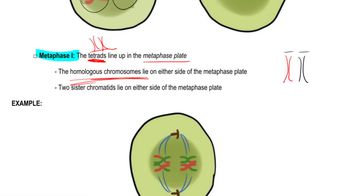
Meiosis Steps
Parental Origin Analysis Using Genetic Markers
Genetic markers such as microsatellites or single nucleotide polymorphisms (SNPs) are used to trace the origin of chromosomes. By comparing the child's chromosome 21 markers with those of the mother and father, researchers can identify whether the extra chromosome came from the mother or father, revealing that most cases are maternal in origin.
Recommended video:
Guided course
Mapping with Markers
Maternal Age Effect
The risk of nondisjunction increases with maternal age, which correlates with the higher incidence of Down syndrome in children born to older mothers. This age-related increase supports the conclusion that the extra chromosome 21 usually originates from errors in the mother’s egg cells during meiosis.
Recommended video:
Guided course
Maternal Effect
Related Videos
Related Practice
Multiple Choice
548
views
4
rank