Which of the following is true regarding the ribosome structure?
Table of contents
- 1. Introduction to Genetics51m
- 2. Mendel's Laws of Inheritance3h 37m
- 3. Extensions to Mendelian Inheritance2h 41m
- 4. Genetic Mapping and Linkage2h 28m
- 5. Genetics of Bacteria and Viruses1h 21m
- 6. Chromosomal Variation1h 48m
- 7. DNA and Chromosome Structure56m
- 8. DNA Replication1h 10m
- 9. Mitosis and Meiosis1h 34m
- 10. Transcription1h 0m
- 11. Translation58m
- 12. Gene Regulation in Prokaryotes1h 19m
- 13. Gene Regulation in Eukaryotes44m
- 14. Genetic Control of Development44m
- 15. Genomes and Genomics1h 50m
- 16. Transposable Elements47m
- 17. Mutation, Repair, and Recombination1h 6m
- 18. Molecular Genetic Tools19m
- 19. Cancer Genetics29m
- 20. Quantitative Genetics1h 26m
- 21. Population Genetics50m
- 22. Evolutionary Genetics29m
11. Translation
Ribosomal Structure
Problem 2
Textbook Question
Write a short essay that discusses the role of ribosomes in the process of translation as it relates to these concepts.
Verified step by step guidance1
Begin by defining translation as the process by which ribosomes synthesize proteins using messenger RNA (mRNA) as a template.
Explain that ribosomes are molecular machines composed of ribosomal RNA (rRNA) and proteins, and they facilitate the decoding of mRNA into a polypeptide chain.
Describe how ribosomes have two main subunits (large and small) that come together during translation to read the mRNA codons and match them with the appropriate transfer RNA (tRNA) molecules carrying specific amino acids.
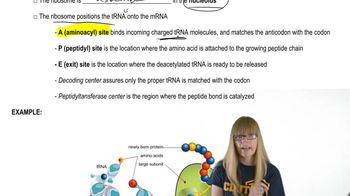
Outline the three key sites within the ribosome: the A (aminoacyl) site, the P (peptidyl) site, and the E (exit) site, and explain their roles in the sequential addition of amino acids to the growing polypeptide chain.
Conclude by discussing how the ribosome moves along the mRNA strand, facilitating the elongation of the protein until a stop codon is reached, signaling termination of translation.
Verified video answer for a similar problem:This video solution was recommended by our tutors as helpful for the problem above
Video duration:
2mPlay a video:
Was this helpful?
Key Concepts
Here are the essential concepts you must grasp in order to answer the question correctly.
Ribosome Structure and Function
Ribosomes are molecular machines composed of rRNA and proteins that facilitate protein synthesis. They consist of two subunits, large and small, which come together during translation to read mRNA and assemble amino acids into polypeptides.
Recommended video:
Guided course
Ribosome Structure
Translation Process
Translation is the process by which ribosomes decode mRNA sequences to synthesize proteins. It involves initiation, elongation, and termination phases, where tRNAs bring specific amino acids that are linked together to form a polypeptide chain.
Recommended video:
Guided course
mRNA Processing
mRNA and tRNA Interaction
mRNA carries the genetic code from DNA, which ribosomes read in codons of three nucleotides. Transfer RNA (tRNA) molecules match these codons with corresponding amino acids via their anticodon regions, enabling accurate protein assembly during translation.
Recommended video:
Guided course
Interacting Genes Overview
Related Videos
Related Practice
Multiple Choice