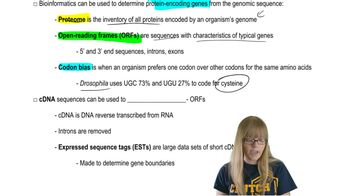
Which of the following is NOT a piece of information that bioinformatics can analyze?
Table of contents
- 1. Introduction to Genetics51m
- 2. Mendel's Laws of Inheritance3h 37m
- 3. Extensions to Mendelian Inheritance2h 41m
- 4. Genetic Mapping and Linkage2h 28m
- 5. Genetics of Bacteria and Viruses1h 21m
- 6. Chromosomal Variation1h 48m
- 7. DNA and Chromosome Structure56m
- 8. DNA Replication1h 10m
- 9. Mitosis and Meiosis1h 34m
- 10. Transcription1h 0m
- 11. Translation58m
- 12. Gene Regulation in Prokaryotes1h 19m
- 13. Gene Regulation in Eukaryotes44m
- 14. Genetic Control of Development44m
- 15. Genomes and Genomics1h 50m
- 16. Transposable Elements47m
- 17. Mutation, Repair, and Recombination1h 6m
- 18. Molecular Genetic Tools19m
- 19. Cancer Genetics29m
- 20. Quantitative Genetics1h 26m
- 21. Population Genetics50m
- 22. Evolutionary Genetics29m
15. Genomes and Genomics
Bioinformatics
Problem 5
Textbook Question
What is bioinformatics, and why is this discipline essential for studying genomes? Provide two examples of bioinformatics applications.
Verified step by step guidance1
Step 1: Define bioinformatics as an interdisciplinary field that combines biology, computer science, and information technology to analyze and interpret biological data, especially large datasets like genomes.
Step 2: Explain why bioinformatics is essential for studying genomes by highlighting that genomes consist of vast amounts of DNA sequence data, which require computational tools to store, organize, analyze, and visualize effectively.
Step 3: Describe how bioinformatics enables researchers to identify genes, predict their functions, and understand genetic variations and evolutionary relationships within and between species.
Step 4: Provide the first example of a bioinformatics application, such as genome sequencing and assembly, where computational methods are used to reconstruct the complete DNA sequence of an organism from smaller fragments.
Step 5: Provide the second example, such as comparative genomics, which uses bioinformatics tools to compare genomes of different organisms to identify conserved genes and regulatory elements, aiding in understanding gene function and evolution.
Verified video answer for a similar problem:This video solution was recommended by our tutors as helpful for the problem above
Video duration:
1mPlay a video:
Was this helpful?
Key Concepts
Here are the essential concepts you must grasp in order to answer the question correctly.
Bioinformatics
Bioinformatics is an interdisciplinary field that combines biology, computer science, and statistics to analyze and interpret biological data, especially genetic sequences. It enables the management and understanding of large datasets like genomes, facilitating discoveries in genetics and molecular biology.
Recommended video:
Guided course
Bioinformatics
Importance of Bioinformatics in Genomics
Bioinformatics is essential for studying genomes because it allows researchers to store, analyze, and compare vast amounts of DNA sequence data efficiently. This helps identify genes, understand genetic variations, and uncover evolutionary relationships, which would be impossible using traditional methods alone.
Recommended video:
Guided course
Bioinformatics
Applications of Bioinformatics
Two common applications of bioinformatics include genome annotation, which involves identifying gene locations and functions within a genome, and comparative genomics, which compares genetic material across species to study evolutionary patterns and gene function. These applications accelerate biological research and medical advancements.
Recommended video:
Guided course
Bioinformatics
Related Videos
Related Practice
Multiple Choice
419
views
1
rank