Pearson+ LogoPearson+ Logo
Ch. 21 - Genomic Analysis
Klug - Concepts of Genetics  12th Edition
Klug12th EditionConcepts of Genetics ISBN: 9780135564776Not the one you use?Change textbook
Chapter 21, Problem 7

How do high-throughput techniques such as computer-automated, next-generation sequencing, and mass spectrometry facilitate research in genomics and proteomics? Explain.

Verified step by step guidance
1
Understand that high-throughput techniques allow researchers to analyze large volumes of genetic or protein data quickly and accurately, which is essential for genomics and proteomics studies.
Recognize that next-generation sequencing (NGS) is a computer-automated method that sequences millions of DNA fragments simultaneously, enabling comprehensive analysis of entire genomes or targeted regions.
Know that mass spectrometry is a technique used in proteomics to identify and quantify proteins by measuring the mass-to-charge ratio of ionized protein fragments, allowing detailed protein characterization.
Appreciate how these technologies generate vast datasets that require computational tools and bioinformatics for data processing, interpretation, and integration, accelerating discoveries in gene function and protein interactions.
Summarize that by combining automation, speed, and precision, these high-throughput methods facilitate large-scale studies that were previously impractical, thus advancing our understanding of biological systems at the molecular level.

Verified video answer for a similar problem:

This video solution was recommended by our tutors as helpful for the problem above.
Video duration:
1m
Was this helpful?

Key Concepts

Here are the essential concepts you must grasp in order to answer the question correctly.

Next-Generation Sequencing (NGS)

NGS is a high-throughput method that rapidly sequences large amounts of DNA or RNA, enabling comprehensive analysis of genomes and transcriptomes. It allows researchers to identify genetic variations, gene expression patterns, and mutations with high accuracy and speed, revolutionizing genomics research.
Recommended video:
Guided course
08:41
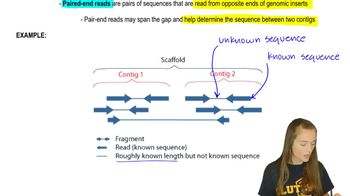
Sequencing Difficulties

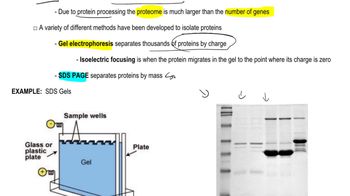
Mass Spectrometry in Proteomics

Mass spectrometry is a technique used to identify and quantify proteins by measuring the mass-to-charge ratio of ionized peptides. It enables detailed analysis of protein composition, post-translational modifications, and interactions, which is essential for understanding cellular functions and protein networks.
Recommended video:

High-Throughput Automation and Data Analysis

Automated high-throughput technologies integrate robotics and computational tools to process and analyze vast biological data efficiently. This automation accelerates experiments, reduces errors, and facilitates large-scale studies in genomics and proteomics by enabling rapid data generation and interpretation.
Recommended video: