Pearson+ LogoPearson+ Logo
Ch. 21 - Genomic Analysis
Klug - Concepts of Genetics  12th Edition
Klug12th EditionConcepts of Genetics ISBN: 9780135564776Not the one you use?Change textbook
Chapter 21, Problem 4

Compare and contrast WGS to a map-based cloning approach.

Verified step by step guidance
1
Step 1: Define Whole Genome Sequencing (WGS) and map-based cloning to establish a clear understanding of each method. WGS involves sequencing the entire genome of an organism to identify genetic variations, while map-based cloning is a targeted approach to identify a gene based on its genetic linkage to known markers.
Step 2: Explain the process of WGS, which includes fragmenting the entire genome, sequencing all fragments, and then assembling these sequences computationally to reconstruct the full genome. This method provides comprehensive data on all genetic variants across the genome.
Step 3: Describe the map-based cloning approach, which starts with identifying a phenotype of interest, then using genetic markers to narrow down the chromosomal region linked to the trait through linkage analysis, followed by isolating and characterizing candidate genes within that region.
Step 4: Compare the scope and resolution of both methods: WGS offers a genome-wide, unbiased approach that can detect all variants but requires extensive data analysis, whereas map-based cloning is more focused and hypothesis-driven, relying on prior genetic mapping information to locate a specific gene.
Step 5: Discuss the advantages and limitations of each method, such as WGS being faster and more comprehensive but potentially more expensive and data-intensive, while map-based cloning is more labor-intensive and time-consuming but useful when the genome is large or poorly annotated.

Verified video answer for a similar problem:

This video solution was recommended by our tutors as helpful for the problem above.
Video duration:
2m
Was this helpful?

Key Concepts

Here are the essential concepts you must grasp in order to answer the question correctly.

Whole Genome Sequencing (WGS)

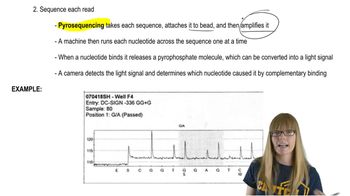
WGS is a method that determines the complete DNA sequence of an organism's genome at once. It provides comprehensive genetic information quickly by sequencing all genomic regions simultaneously, enabling identification of mutations or variants without prior knowledge of gene location.
Recommended video:
Guided course
08:55
Sequencing Overview

Map-Based Cloning

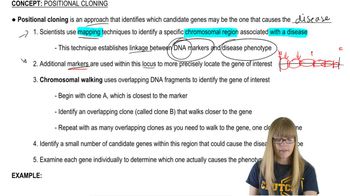
Map-based cloning is a targeted approach to identify genes by first locating their approximate position on a genetic map using markers. It involves stepwise narrowing down of the region through linkage analysis and physical mapping before sequencing the candidate gene.
Recommended video:
Guided course
07:
Positional Cloning

Comparison of WGS and Map-Based Cloning

WGS offers a rapid, unbiased genome-wide analysis, while map-based cloning is labor-intensive and focused on specific loci. WGS bypasses the need for prior mapping but may require complex data analysis, whereas map-based cloning provides precise gene localization but is slower and depends on genetic markers.
Recommended video:
Guided course
07:
Positional Cloning
Related Practice
Textbook Question

In the discussion we focused on the analysis of genomes, transcriptomes, and proteomes and considered important applications and findings from these endeavors. At the same time, we found many opportunities to consider the methods and reasoning by which much of this information was acquired. From the explanations given in the chapter, what answers would you propose to the following fundamental questions?

How have microarrays demonstrated that, although all cells of an organism have the same genome, some genes are expressed in almost all cells, whereas other genes show cell- and tissue-specific expression?

454
views
Textbook Question

Write a short essay that explains how recombinant DNA techniques were used to identify and study genes compared to how modern genomic techniques have revolutionized the cloning and analysis of genes.

503
views
Textbook Question

What is functional genomics? How does it differ from comparative genomics?

757
views
Textbook Question

What is bioinformatics, and why is this discipline essential for studying genomes? Provide two examples of bioinformatics applications.

641
views
Textbook Question

Annotation involves identifying genes and gene-regulatory sequences in a genome. List and describe characteristics of a genome that are hallmarks for identifying genes in an unknown sequence. What characteristics would you look for in a bacterial genome? A eukaryotic genome?

844
views
Textbook Question

How do high-throughput techniques such as computer-automated, next-generation sequencing, and mass spectrometry facilitate research in genomics and proteomics? Explain.

849
views