Which of the following is an example of natural selection?
Table of contents
- 1. Introduction to Genetics51m
- 2. Mendel's Laws of Inheritance3h 37m
- 3. Extensions to Mendelian Inheritance2h 41m
- 4. Genetic Mapping and Linkage2h 28m
- 5. Genetics of Bacteria and Viruses1h 21m
- 6. Chromosomal Variation1h 48m
- 7. DNA and Chromosome Structure56m
- 8. DNA Replication1h 10m
- 9. Mitosis and Meiosis1h 34m
- 10. Transcription1h 0m
- 11. Translation58m
- 12. Gene Regulation in Prokaryotes1h 19m
- 13. Gene Regulation in Eukaryotes44m
- 14. Genetic Control of Development44m
- 15. Genomes and Genomics1h 50m
- 16. Transposable Elements47m
- 17. Mutation, Repair, and Recombination1h 6m
- 18. Molecular Genetic Tools19m
- 19. Cancer Genetics29m
- 20. Quantitative Genetics1h 26m
- 21. Population Genetics50m
- 22. Evolutionary Genetics29m
21. Population Genetics
Allelic Frequency Changes
Problem 1e
Textbook Question
How do we know the age of the last common ancestor shared by two species?
Verified step by step guidance1
Understand that the age of the last common ancestor (LCA) shared by two species is estimated using molecular data and fossil records, which provide information about evolutionary divergence times.
Collect genetic sequence data (such as DNA, RNA, or protein sequences) from both species to compare their similarities and differences.
Calculate the genetic distance between the two species by determining the number of molecular changes or mutations that have accumulated since their divergence.
Use a molecular clock model, which assumes a relatively constant rate of genetic mutations over time, to convert the genetic distance into an estimate of divergence time. The basic formula is: \[\text{Divergence Time} = \frac{\text{Genetic Distance}}{2 \times \text{Mutation Rate}}\] where the factor 2 accounts for mutations accumulating independently in both lineages.
Calibrate the molecular clock using fossil evidence or known geological events to improve the accuracy of the estimated age of the last common ancestor.
Verified video answer for a similar problem:This video solution was recommended by our tutors as helpful for the problem above
Video duration:
1mPlay a video:
Was this helpful?
Key Concepts
Here are the essential concepts you must grasp in order to answer the question correctly.
Molecular Clock
The molecular clock is a method that estimates the time of divergence between species by measuring the number of genetic mutations accumulated over time. It assumes mutations occur at a relatively constant rate, allowing scientists to infer the age of the last common ancestor based on genetic differences.
Recommended video:
Guided course
Mapping with Markers
Phylogenetic Trees
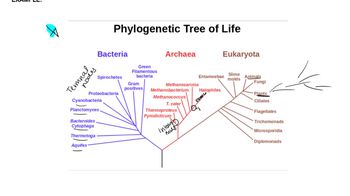
Phylogenetic trees are diagrams that depict evolutionary relationships among species based on genetic or morphological data. By analyzing branching patterns and genetic distances, researchers can identify common ancestors and estimate when species diverged from one another.
Recommended video:
Guided course
Phylogenetic Trees
Fossil Record and Calibration
The fossil record provides physical evidence of past organisms and helps calibrate molecular clocks by offering minimum age estimates for divergence events. Combining fossil data with genetic information improves accuracy in dating the last common ancestor of species.
Related Videos
Related Practice
Multiple Choice
482
views
4
rank
