

Pearson+ LogoPearson+ Logo
Ch. 23 - Developmental Genetics
Klug - Concepts of Genetics  12th Edition
Klug12th EditionConcepts of Genetics ISBN: 9780135564776Not the one you use?Change textbook
Chapter 23, Problem 10

How can you determine whether a particular gene is being transcribed in different cell types?

Verified step by step guidance
1
Extract RNA from the different cell types you want to study. This is done because RNA is the molecule that reflects active transcription of genes.
Perform reverse transcription to convert the RNA into complementary DNA (cDNA). This step is necessary because DNA is more stable and can be amplified for analysis.
Use quantitative PCR (qPCR) or real-time PCR to amplify the cDNA corresponding to the gene of interest. Design primers specific to the gene you want to study to ensure only that gene is amplified.
Analyze the qPCR results to compare the levels of cDNA (and thus RNA) for the gene of interest across the different cell types. Higher levels of cDNA indicate higher transcription of the gene in that cell type.
Optionally, confirm the results using another method, such as Northern blotting or RNA sequencing, to ensure the accuracy of your findings.

Verified video answer for a similar problem:

This video solution was recommended by our tutors as helpful for the problem above.
Video duration:
3m
Was this helpful?

Key Concepts

Here are the essential concepts you must grasp in order to answer the question correctly.

Gene Transcription

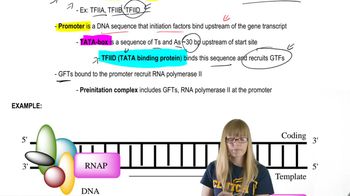
Gene transcription is the process by which a specific segment of DNA is copied into RNA by the enzyme RNA polymerase. This process is crucial for gene expression, as it determines whether a gene is active and producing its corresponding protein. Understanding transcription is essential for analyzing gene activity across different cell types.
Recommended video:
Guided course
09:16
Eukaryotic Transcription

Cell Type-Specific Expression

Cell type-specific expression refers to the phenomenon where certain genes are expressed in some cell types but not in others. This differential expression is regulated by various factors, including transcription factors and epigenetic modifications, which can influence the accessibility of DNA to the transcription machinery. Recognizing this concept is vital for determining gene activity in various cellular contexts.
Recommended video:
Guided course
02:09
Penetrance and Expressivity

Techniques for Measuring Transcription

Several techniques can be employed to measure gene transcription, including quantitative PCR, RNA sequencing, and in situ hybridization. These methods allow researchers to quantify RNA levels and assess whether a gene is being transcribed in different cell types. Familiarity with these techniques is crucial for effectively answering questions about gene expression patterns.
Recommended video:
Guided course
11:06
Mathematical Measurements