Pearson+ LogoPearson+ Logo
Ch. 23 - Developmental Genetics
Klug - Concepts of Genetics  12th Edition
Klug12th EditionConcepts of Genetics ISBN: 9780135564776Not the one you use?Change textbook
Chapter 23, Problem 9

Experiments have shown that any nuclei placed in the polar cytoplasm at the posterior pole of the Drosophila egg will differentiate into germ cells. If polar cytoplasm is transplanted into the anterior end of the egg just after fertilization, what will happen to nuclei that migrate into this cytoplasm at the anterior pole?

Verified step by step guidance
1
Understand the concept of polar cytoplasm: In Drosophila development, the polar cytoplasm at the posterior pole contains determinants that specify germ cell fate. These determinants are critical for the differentiation of nuclei into germ cells.
Recognize the experimental setup: The problem describes a scenario where polar cytoplasm is transplanted from the posterior pole to the anterior pole of the egg after fertilization. This means the anterior pole now contains the same germ cell determinants as the posterior pole.
Consider the behavior of nuclei: Nuclei that migrate into the polar cytoplasm at the posterior pole normally differentiate into germ cells due to the presence of germ cell determinants. Similarly, nuclei that migrate into the transplanted polar cytoplasm at the anterior pole will encounter the same determinants.
Predict the outcome: Since the anterior pole now contains polar cytoplasm with germ cell determinants, any nuclei that migrate into this region will likely differentiate into germ cells, just as they would at the posterior pole.
Conclude the reasoning: The transplantation of polar cytoplasm effectively creates a second region in the egg where germ cell differentiation can occur, leading to the formation of germ cells at both the anterior and posterior poles.

Verified video answer for a similar problem:

This video solution was recommended by our tutors as helpful for the problem above.
Video duration:
1m
Was this helpful?

Key Concepts

Here are the essential concepts you must grasp in order to answer the question correctly.

Polar Cytoplasm

Polar cytoplasm refers to the specialized cytoplasmic region in the Drosophila egg that contains factors necessary for germ cell development. This cytoplasm is crucial for determining the fate of nuclei that enter it, as it provides the signals and environment needed for germ cell differentiation.
Recommended video:
Guided course
21:21
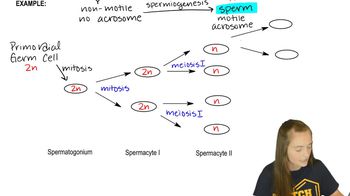
Gamete Development

Germ Cell Differentiation

Germ cell differentiation is the process by which specific cells develop into gametes, such as sperm and eggs. In Drosophila, this process is influenced by the presence of polar cytoplasm, which directs the fate of nuclei that migrate into it, leading to the formation of germ cells from somatic nuclei.
Recommended video:
Guided course
03:52
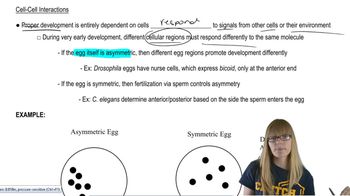
Cell-cell interactions

Nuclear Migration

Nuclear migration is the movement of nuclei within the cytoplasm of a cell, which is essential for proper cell function and development. In the context of the Drosophila egg, nuclei that migrate into the polar cytoplasm at the anterior pole may not receive the same differentiation signals as those at the posterior pole, potentially leading to different developmental outcomes.
Recommended video:
Guided course
03:03
New Alleles and Migration