Table of contents
- 1. Introduction to Genetics51m
- 2. Mendel's Laws of Inheritance3h 37m
- 3. Extensions to Mendelian Inheritance2h 41m
- 4. Genetic Mapping and Linkage2h 28m
- 5. Genetics of Bacteria and Viruses1h 21m
- 6. Chromosomal Variation1h 48m
- 7. DNA and Chromosome Structure56m
- 8. DNA Replication1h 10m
- 9. Mitosis and Meiosis1h 34m
- 10. Transcription1h 0m
- 11. Translation58m
- 12. Gene Regulation in Prokaryotes1h 19m
- 13. Gene Regulation in Eukaryotes44m
- 14. Genetic Control of Development44m
- 15. Genomes and Genomics1h 50m
- 16. Transposable Elements47m
- 17. Mutation, Repair, and Recombination1h 6m
- 18. Molecular Genetic Tools19m
- 19. Cancer Genetics29m
- 20. Quantitative Genetics1h 26m
- 21. Population Genetics50m
- 22. Evolutionary Genetics29m
2. Mendel's Laws of Inheritance
Pedigrees
Problem 1b
Textbook Question
How do we know whether an organism expressing a dominant trait is homozygous or heterozygous?
Verified step by step guidance1
Understand that an organism expressing a dominant trait can have two possible genotypes: homozygous dominant (e.g., \(AA\)) or heterozygous (e.g., \(Aa\)). Both genotypes show the dominant phenotype, so phenotype alone does not distinguish them.
Perform a test cross by mating the organism with a homozygous recessive individual (e.g., \(aa\)), which will only contribute recessive alleles to the offspring.
Analyze the offspring phenotypes: if all offspring show the dominant trait, the tested organism is likely homozygous dominant; if some offspring show the recessive trait, the tested organism is heterozygous.
Use the expected Mendelian ratios to predict offspring genotypes and phenotypes from the test cross: for a heterozygous parent (\(Aa\)) crossed with \(aa\), expect approximately 50% dominant and 50% recessive offspring.
Conclude the genotype of the original organism based on the presence or absence of recessive phenotype offspring in the test cross.
Verified video answer for a similar problem:This video solution was recommended by our tutors as helpful for the problem above
Video duration:
2mPlay a video:
Was this helpful?
Key Concepts
Here are the essential concepts you must grasp in order to answer the question correctly.
Dominant and Recessive Alleles
Dominant alleles express their trait even if only one copy is present, while recessive alleles require two copies to show their trait. Understanding this helps distinguish between organisms that show a dominant trait due to one or two dominant alleles.
Recommended video:
Guided course
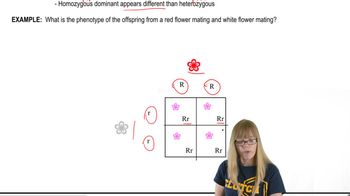
Variations on Dominance
Genotype vs. Phenotype
Phenotype is the observable trait, while genotype is the genetic makeup. An organism with a dominant phenotype could have either a homozygous dominant or heterozygous genotype, so knowing the difference is key to identifying the underlying genetic composition.
Recommended video:
Guided course
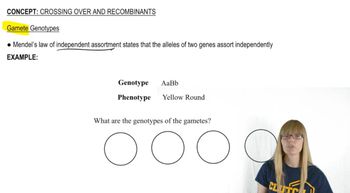
Gamete Genotypes
Test Cross
A test cross involves breeding the organism with a homozygous recessive individual to determine its genotype. If any offspring show the recessive trait, the tested organism is heterozygous; if all offspring show the dominant trait, it is likely homozygous dominant.
Recommended video:
Guided course
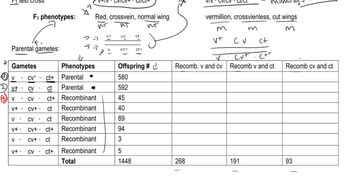
Trihybrid Cross
Related Videos
Related Practice
Multiple Choice
In a pedigree showing an autosomal recessive disorder, which of the following is most likely true about the parents of an affected individual?
20
views