Flower color may be red, white, or pink, and flower shape may be personate or peloric. For the following crosses, determine the P₁ and F₁ genotypes:
Table of contents
- 1. Introduction to Genetics51m
- 2. Mendel's Laws of Inheritance3h 37m
- 3. Extensions to Mendelian Inheritance2h 41m
- 4. Genetic Mapping and Linkage2h 28m
- 5. Genetics of Bacteria and Viruses1h 21m
- 6. Chromosomal Variation1h 48m
- 7. DNA and Chromosome Structure56m
- 8. DNA Replication1h 10m
- 9. Mitosis and Meiosis1h 34m
- 10. Transcription1h 0m
- 11. Translation58m
- 12. Gene Regulation in Prokaryotes1h 19m
- 13. Gene Regulation in Eukaryotes44m
- 14. Genetic Control of Development44m
- 15. Genomes and Genomics1h 50m
- 16. Transposable Elements47m
- 17. Mutation, Repair, and Recombination1h 6m
- 18. Molecular Genetic Tools19m
- 19. Cancer Genetics29m
- 20. Quantitative Genetics1h 26m
- 21. Population Genetics50m
- 22. Evolutionary Genetics29m
4. Genetic Mapping and Linkage
Trihybrid Cross
Problem 22c
Textbook Question
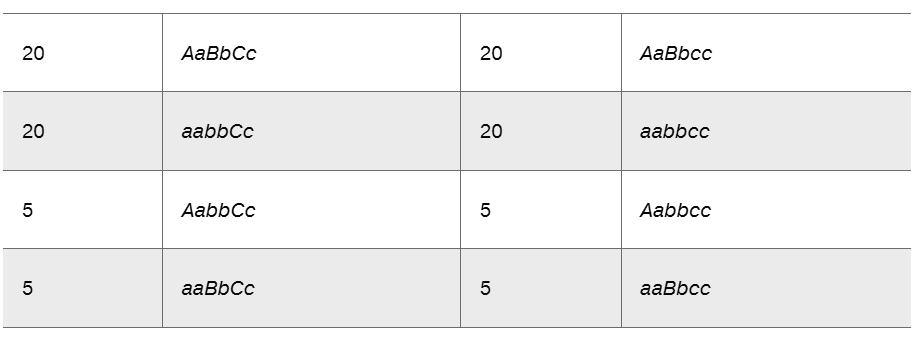
An organism of the genotype AaBbCc was testcrossed to a triply recessive organism (aabbcc). The genotypes of the progeny are presented in the following table.

What can you conclude from the actual data about the location of the three genes in relation to one another?
Verified step by step guidance1
Step 1: Identify the parental and recombinant genotypes from the progeny data. The parental genotypes are expected to be the most frequent classes, while recombinant genotypes appear less frequently. Here, the genotypes with counts of 20 are likely parental types, and those with counts of 5 are recombinant types.
Step 2: Group the progeny into parental and recombinant classes. Parental genotypes: AaBbCc, AaBbcc, aabbCc, aabbcc (each with 20 progeny). Recombinant genotypes: AabbCc, Aabbcc, aaBbCc, aaBbcc (each with 5 progeny).
Step 3: Determine which genes are linked by analyzing the frequency of recombination between gene pairs. Calculate recombination frequencies for each gene pair by summing the recombinant progeny involving those genes and dividing by the total progeny number.
Step 4: Use the recombination frequencies to infer gene order. The gene pairs with the lowest recombination frequency are closest together, while the pair with the highest recombination frequency is farthest apart. This helps establish the linear order of the three genes on the chromosome.
Step 5: Conclude whether the genes are linked or assort independently. If recombination frequencies are significantly less than 50%, the genes are linked. If close to 50%, the genes assort independently. Based on the data, interpret the linkage relationships and gene order.
Verified video answer for a similar problem:This video solution was recommended by our tutors as helpful for the problem above
Video duration:
1mPlay a video:
Was this helpful?
Key Concepts
Here are the essential concepts you must grasp in order to answer the question correctly.
Testcross and Its Purpose
A testcross involves crossing an organism with a dominant phenotype but unknown genotype with a homozygous recessive organism. This helps reveal the genotype of the first organism by analyzing the phenotypes and genotypes of the progeny, especially useful for studying gene linkage and recombination.
Recommended video:
Guided course
Purpose of X Inactivation
Gene Linkage and Recombination
Genes located close together on the same chromosome tend to be inherited together, a phenomenon called linkage. Recombination occurs when crossing over during meiosis exchanges genetic material between homologous chromosomes, producing new allele combinations. The frequency of recombinant offspring indicates the distance between genes.
Recommended video:
Guided course
Chi Square and Linkage
Interpreting Progeny Ratios to Map Genes
By comparing the number of parental-type progeny to recombinant types in a testcross, one can infer gene order and relative distances. Higher numbers of parental genotypes suggest linkage, while recombinant genotypes indicate crossover events. Mapping genes involves calculating recombination frequencies to determine gene positions.
Recommended video:
Guided course
Mapping Genes
Related Videos
Related Practice
Textbook Question
507
views
