If the cross described in Problem 18 were made, and if Sb and cu are 8.2 map units apart on chromosome III, and if 1000 offspring were recovered, what would be the outcome of the cross, assuming that equal numbers of males and females were observed?

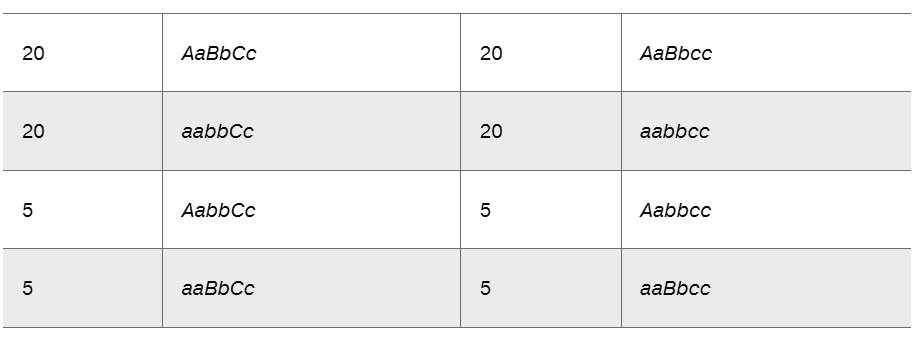
An organism of the genotype AaBbCc was testcrossed to a triply recessive organism (aabbcc). The genotypes of the progeny are presented in the following table.

If these three genes were all assorting independently, how many genotypic and phenotypic classes would result in the offspring, and in what proportion, assuming simple dominance and recessiveness in each gene pair?
Verified step by step guidance
Verified video answer for a similar problem:
Key Concepts
Independent Assortment
Testcross and Genotypic Classes
Phenotypic Ratios and Dominance
Are mitotic recombinations and sister chromatid exchanges effective in producing genetic variability in an individual? in the offspring of individuals?
What possible conclusions can be drawn from the observations that in male Drosophila, no crossing over occurs, and that during meiosis, synaptonemal complexes are not seen in males but are observed in females where crossing over occurs?
An organism of the genotype AaBbCc was testcrossed to a triply recessive organism (aabbcc). The genotypes of the progeny are presented in the following table.
Answer part (a) again, assuming the three genes are so tightly linked on a single chromosome that no crossover gametes were recovered in the sample of offspring.
An organism of the genotype AaBbCc was testcrossed to a triply recessive organism (aabbcc). The genotypes of the progeny are presented in the following table.
What can you conclude from the actual data about the location of the three genes in relation to one another?
Based on our discussion of the potential inaccuracy of mapping, would you revise your answer to Problem 22? If so, how?
