Which of the following forms of DNA damage is NOT caused spontaneously?
Table of contents
- 1. Introduction to Genetics51m
- 2. Mendel's Laws of Inheritance3h 37m
- 3. Extensions to Mendelian Inheritance2h 41m
- 4. Genetic Mapping and Linkage2h 28m
- 5. Genetics of Bacteria and Viruses1h 21m
- 6. Chromosomal Variation1h 48m
- 7. DNA and Chromosome Structure56m
- 8. DNA Replication1h 10m
- 9. Mitosis and Meiosis1h 34m
- 10. Transcription1h 0m
- 11. Translation58m
- 12. Gene Regulation in Prokaryotes1h 19m
- 13. Gene Regulation in Eukaryotes44m
- 14. Genetic Control of Development44m
- 15. Genomes and Genomics1h 50m
- 16. Transposable Elements47m
- 17. Mutation, Repair, and Recombination1h 6m
- 18. Molecular Genetic Tools19m
- 19. Cancer Genetics29m
- 20. Quantitative Genetics1h 26m
- 21. Population Genetics50m
- 22. Evolutionary Genetics29m
17. Mutation, Repair, and Recombination
Spontaneous Mutations
Problem 18
Textbook Question
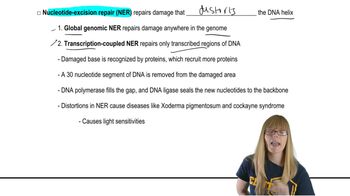
What genetic defects result in the disorder xeroderma pigmentosum (XP) in humans? How do these defects create the phenotypes associated with the disorder?
Verified step by step guidance1
Understand that xeroderma pigmentosum (XP) is caused by mutations in genes responsible for nucleotide excision repair (NER), a DNA repair pathway that fixes damage caused by ultraviolet (UV) light.
Identify the key genes involved in XP, such as XPA, XPB, XPC, XPD, XPE, XPF, and XPG, which encode proteins that recognize and excise UV-induced DNA lesions like thymine dimers.
Explain that defects in these genes impair the NER pathway, leading to an inability to properly repair UV-induced DNA damage, resulting in accumulation of mutations in skin cells.
Connect the accumulation of unrepaired DNA damage to the clinical phenotypes of XP, including extreme sensitivity to sunlight, freckling, pigmentation abnormalities, and a high predisposition to skin cancers.
Summarize that the genetic defects cause a failure in DNA repair mechanisms, which leads to cellular damage and the characteristic symptoms of XP due to increased mutagenesis and cell death in UV-exposed tissues.
Verified video answer for a similar problem:This video solution was recommended by our tutors as helpful for the problem above
Video duration:
3mPlay a video:
Was this helpful?
Key Concepts
Here are the essential concepts you must grasp in order to answer the question correctly.
Nucleotide Excision Repair (NER) Pathway
NER is a DNA repair mechanism that removes bulky DNA lesions, such as those caused by UV light-induced thymine dimers. It involves recognition, excision, and resynthesis of damaged DNA segments. Defects in NER genes impair this process, leading to accumulation of DNA damage.
Recommended video:
Guided course
Repair Pathways
Genetic Mutations in XP-Related Genes
Xeroderma pigmentosum results from mutations in genes encoding proteins essential for NER, such as XPA, XPB, XPC, and others. These mutations reduce or eliminate repair activity, causing cells to be hypersensitive to UV-induced DNA damage.
Recommended video:
Guided course
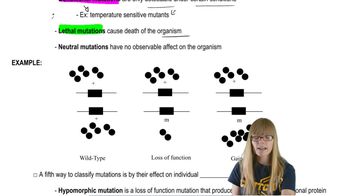
Mutations and Phenotypes
Phenotypic Consequences of DNA Repair Defects
Failure to repair UV-induced DNA damage leads to mutations, genomic instability, and cell death. Clinically, this manifests as extreme UV sensitivity, skin abnormalities, pigmentation changes, and a high risk of skin cancers characteristic of XP patients.
Recommended video:
Guided course
Repair Pathways
Related Videos
Related Practice
Multiple Choice
513
views
3
rank
