What are the exceptions to the general rule that DNA is the genetic material in all organisms? What evidence supports these exceptions?
Ch. 10 - DNA Structure and Analysis

Chapter 10, Problem 12
Adenine may also be named 6-amino purine. How would you name the other four nitrogenous bases, using this alternative system? (O is indicated by 'oxy-,' and CH₃ by 'methyl.')
Verified step by step guidance1
Understand that adenine is named 6-amino purine because it has an amino group (–NH₂) attached to the 6th carbon of the purine ring. This naming system focuses on the functional groups attached to the purine or pyrimidine ring.
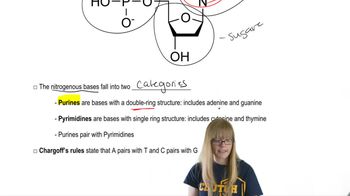
Identify the base type for each nitrogenous base: guanine and adenine are purines (two-ring structures), while cytosine, thymine, and uracil are pyrimidines (single-ring structures).
For guanine, note that it has an amino group at position 2 and an oxygen (oxo group) at position 6 on the purine ring. Using the alternative system, name it as 2-amino-6-oxy purine.
For cytosine, which is a pyrimidine, it has an amino group at position 4 and an oxygen at position 2. Name it as 4-amino-2-oxy pyrimidine.
For thymine and uracil, both are pyrimidines with oxygen atoms at positions 2 and 4. Thymine has an additional methyl group at position 5. Name uracil as 2,4-dioxy pyrimidine and thymine as 5-methyl-2,4-dioxy pyrimidine.

Verified video answer for a similar problem:
This video solution was recommended by our tutors as helpful for the problem above.
Video duration:
3mWas this helpful?
Key Concepts
Here are the essential concepts you must grasp in order to answer the question correctly.
Nitrogenous Base Structure and Classification
Nitrogenous bases are organic molecules that form the building blocks of nucleic acids. They are classified into purines (adenine and guanine) with a double-ring structure, and pyrimidines (cytosine, thymine, uracil) with a single-ring. Understanding their chemical structure is essential for systematic naming based on functional groups.
Recommended video:
Guided course
DNA Structure
Functional Group Nomenclature in Nitrogenous Bases
The alternative naming system uses functional groups like amino (-NH2), oxy (=O), and methyl (-CH3) to describe nitrogenous bases. For example, adenine is 6-amino purine, indicating an amino group at position 6 on the purine ring. Recognizing these groups and their positions allows systematic naming of other bases.
Recommended video:
Guided course
Functional Genomics
Position Numbering in Purine and Pyrimidine Rings
Purine and pyrimidine rings have standardized numbering systems to identify the location of substituents. For purines, numbering starts at the nitrogen in the six-membered ring, while for pyrimidines, numbering begins at the nitrogen in the ring. Correct numbering is crucial for accurately naming functional groups on the bases.
Recommended video:
Guided course
Positional Cloning
Related Practice
Textbook Question
882
views
Textbook Question
Draw the chemical structure of the three components of a nucleotide, and then link the three together. What atoms are removed from the structures when the linkages are formed?
856
views
Textbook Question
How are the carbon and nitrogen atoms of the sugars, purines, and pyrimidines numbered?
793
views
Textbook Question
Draw the chemical structure of a dinucleotide composed of A and G. Opposite this structure, draw the dinucleotide composed of T and C in an antiparallel (or upside-down) fashion. Form the possible hydrogen bonds.
1001
views
Textbook Question
Describe the various characteristics of the Watson–Crick double-helix model for DNA.
763
views
Textbook Question
What evidence did Watson and Crick have at their disposal in 1953? What was their approach in arriving at the structure of DNA?
878
views