Adenine may also be named 6-amino purine. How would you name the other four nitrogenous bases, using this alternative system? (O is indicated by 'oxy-,' and CH₃ by 'methyl.')
Ch. 10 - DNA Structure and Analysis

Chapter 10, Problem 15
What evidence did Watson and Crick have at their disposal in 1953? What was their approach in arriving at the structure of DNA?
Verified step by step guidance1
Understand the historical context: Watson and Crick worked in 1953 when the structure of DNA was unknown, but several key pieces of experimental evidence were already available.
Identify the main evidence they used: They had access to X-ray diffraction images of DNA, particularly the famous Photo 51 taken by Rosalind Franklin, which suggested a helical structure.
Consider Chargaff's rules: They knew from Erwin Chargaff's findings that the amount of adenine (A) equals thymine (T), and the amount of guanine (G) equals cytosine (C), indicating base pairing.
Recognize their approach: Watson and Crick used model building, combining the chemical knowledge of nucleotide components and the physical constraints suggested by the X-ray data to propose a double helix structure.
Summarize their reasoning: They integrated experimental data (X-ray diffraction and base composition) with chemical principles to deduce that DNA consists of two antiparallel strands forming a double helix with complementary base pairing.

Verified video answer for a similar problem:
This video solution was recommended by our tutors as helpful for the problem above.
Video duration:
2mWas this helpful?
Key Concepts
Here are the essential concepts you must grasp in order to answer the question correctly.
X-ray Crystallography
X-ray crystallography is a technique used to determine the three-dimensional structure of molecules by analyzing the pattern of X-rays diffracted through crystallized samples. Rosalind Franklin's X-ray diffraction images of DNA, especially Photo 51, provided critical evidence about the helical structure and dimensions of DNA that guided Watson and Crick.
Recommended video:
Guided course
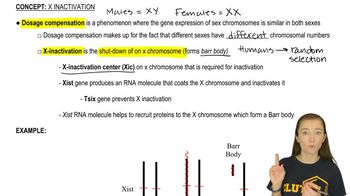
X-Inactivation
Base Pairing and Complementarity
Base pairing refers to the specific hydrogen bonding between nucleotide bases: adenine pairs with thymine, and guanine pairs with cytosine. Watson and Crick used Chargaff's rules, which showed equal amounts of A and T and equal amounts of G and C, to propose complementary base pairs that explained DNA's uniform width and replication mechanism.
Recommended video:
Guided course
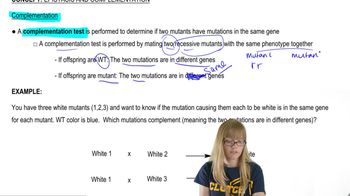
Complementation
Model Building Approach
Watson and Crick used a model-building approach, assembling physical models of DNA components to test structural hypotheses. By integrating experimental data and chemical knowledge, they iteratively refined their model to fit the known constraints, ultimately proposing the double helix structure that explained DNA's properties.
Recommended video:
Guided course
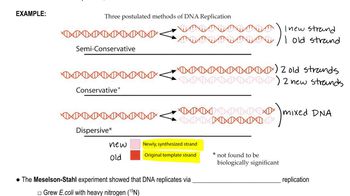
Semiconservative Replication
Related Practice
Textbook Question
995
views
Textbook Question
Draw the chemical structure of a dinucleotide composed of A and G. Opposite this structure, draw the dinucleotide composed of T and C in an antiparallel (or upside-down) fashion. Form the possible hydrogen bonds.
1001
views
Textbook Question
Describe the various characteristics of the Watson–Crick double-helix model for DNA.
763
views
Textbook Question
What might Watson and Crick have concluded had Chargaff's data from a single source indicated the following?
Why would this conclusion be contradictory to Wilkins's and Franklin's data?
549
views
Textbook Question
How do covalent bonds differ from hydrogen bonds? Define base complementarity.
799
views
Textbook Question
List three main differences between DNA and RNA.
1158
views