Pearson+ LogoPearson+ Logo
Ch. 11 - DNA Replication and Recombination
Klug - Concepts of Genetics  12th Edition
Klug12th EditionConcepts of Genetics ISBN: 9780135564776Not the one you use?Change textbook
Chapter 11, Problem 30c

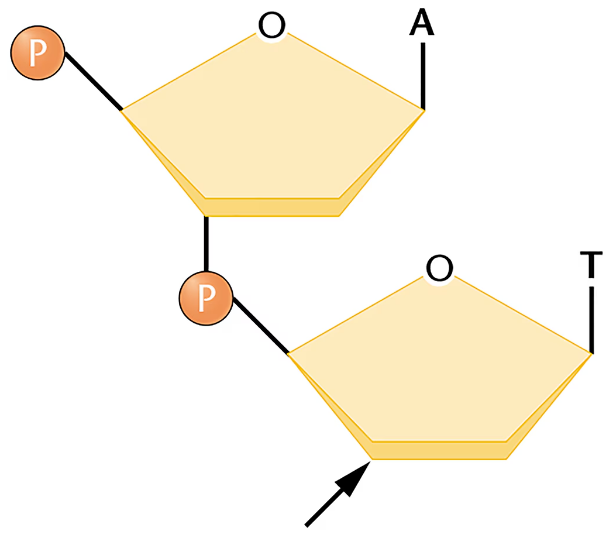
Consider the drawing of a dinucleotide below.
Suppose that the molecule was cleaved with the enzyme spleen phosphodiesterase, which breaks the covalent bond connecting the phosphate to C-5'. After cleavage, to which nucleoside is the phosphate now attached (A or T)?
Diagram of a dinucleotide showing phosphate groups linked to adenine and thymine sugars with a cleavage site at thymine C-5'.

Verified step by step guidance
1
Understand the structure of a dinucleotide: A dinucleotide consists of two nucleotides connected by a phosphodiester bond. Each nucleotide is made up of a sugar (deoxyribose in DNA), a phosphate group, and a nitrogenous base (Adenine (A) or Thymine (T) in this case).
Identify the role of spleen phosphodiesterase: This enzyme specifically cleaves the phosphodiester bond between the phosphate group and the 5' carbon of the sugar in the nucleotide. This means the phosphate group will no longer be attached to the 5' carbon of one nucleotide.
Determine the result of cleavage: After the cleavage, the phosphate group will remain attached to the 3' carbon of the sugar in the adjacent nucleotide. This is because the phosphodiester bond connects the 5' carbon of one nucleotide to the 3' carbon of the next nucleotide.
Analyze the dinucleotide structure: In the given dinucleotide, identify which nucleotide (A or T) has its phosphate group originally attached to the 5' carbon. After cleavage, the phosphate will transfer to the 3' carbon of the adjacent nucleotide.
Conclude the attachment: Based on the cleavage mechanism, determine whether the phosphate group is now attached to the nucleoside containing Adenine (A) or Thymine (T). This depends on the orientation of the dinucleotide and the position of the cleavage.

Verified video answer for a similar problem:

This video solution was recommended by our tutors as helpful for the problem above.
Video duration:
1m
Was this helpful?

Key Concepts

Here are the essential concepts you must grasp in order to answer the question correctly.

Nucleotides and Nucleosides

Nucleotides are the building blocks of nucleic acids, consisting of a phosphate group, a sugar (ribose or deoxyribose), and a nitrogenous base (adenine, thymine, cytosine, or guanine). Nucleosides are similar but lack the phosphate group, comprising only the sugar and the nitrogenous base. Understanding the difference between these two is crucial for analyzing the effects of enzymatic cleavage on nucleic acid structure.
Recommended video:
Guided course
06:25
DNA Structure

Phosphodiester Bonds

Phosphodiester bonds are covalent linkages that connect the phosphate group of one nucleotide to the hydroxyl group on the sugar of another nucleotide, forming the backbone of DNA and RNA. The cleavage of these bonds by enzymes like spleen phosphodiesterase alters the structure of nucleic acids, impacting their function and stability. Recognizing how these bonds are formed and broken is essential for understanding the question.
Recommended video:
Guided course
06:25
DNA Structure

Enzymatic Cleavage

Enzymatic cleavage refers to the process by which enzymes break specific chemical bonds in molecules. In this case, spleen phosphodiesterase cleaves the bond between the phosphate group and the C-5' carbon of the sugar in a nucleotide. This action determines the attachment of the phosphate group to either adenine (A) or thymine (T), which is critical for answering the question regarding the resulting nucleoside.
Recommended video:
Guided course
04:30
Post Translational Modifications
Related Practice
Textbook Question

Reiji and Tuneko Okazaki conducted a now classic experiment in 1968 in which they discovered a population of short fragments synthesized during DNA replication. They introduced a short pulse of ³H-thymidine into a culture of E. coli and extracted DNA from the cells at various intervals. In analyzing the DNA after centrifugation in denaturing gradients, they noticed that as the interval between the time of ³H-thymidine introduction and the time of centrifugation increased, the proportion of short strands decreased and more labeled DNA was found in larger strands. What would account for this observation?

1262
views
Textbook Question

Consider the drawing of a dinucleotide below.

Is it DNA or RNA?

657
views
Textbook Question

Consider the drawing of a dinucleotide below.

Is the arrow closest to the 5' or the 3' end?

448
views
Textbook Question

To gauge the fidelity of DNA synthesis, Arthur Kornberg and colleagues devised a technique called nearest-neighbor analysis, which determines the frequency with which any two bases occur adjacent to each other along the polynucleotide chain (J. Biol. Chem. 236: 864–875). This test relies on the enzyme spleen phosphodiesterase (see the previous problem). DNA is synthesized by polymerization of 5'-nucleotides—that is, each nucleotide is added with the phosphate on the deoxyribose. However, as shown in the accompanying figure, the phosphodiesterase enzyme cleaves DNA between the phosphate and the C-5' atom, thereby producing 3'-nucleotides. In this test, the phosphates on only one of the four nucleotide precursors of DNA (cytidylic acid, for example) are made radioactive with ³²P, and DNA is synthesized. Then the DNA is subjected to enzymatic cleavage, in which the radioactive phosphate is transferred to the base that is the 'nearest neighbor' on the 5' side of all cytidylic acid nucleotides.

Following four separate experiments, in each of which a different one of the four nucleotide types is radioactive, the frequency of all 16 possible nearest neighbors can be calculated. When Kornberg applied the nearest-neighbor frequency test to the DNA template and resultant product from a variety of experiments, he found general agreement between the nearest-neighbor frequencies of the two. Analysis of nearest-neighbor data led Kornberg to conclude that the two strands of the double helix are in opposite polarity to one another. Demonstrate this approach by determining the outcome of such an analysis if the strands of DNA shown here are (a) antiparallel versus (b) parallel:

543
views