Pearson+ LogoPearson+ Logo
Ch. 11 - DNA Replication and Recombination
Klug - Concepts of Genetics  12th Edition
Klug12th EditionConcepts of Genetics ISBN: 9780135564776Not the one you use?Change textbook
Chapter 11, Problem 31

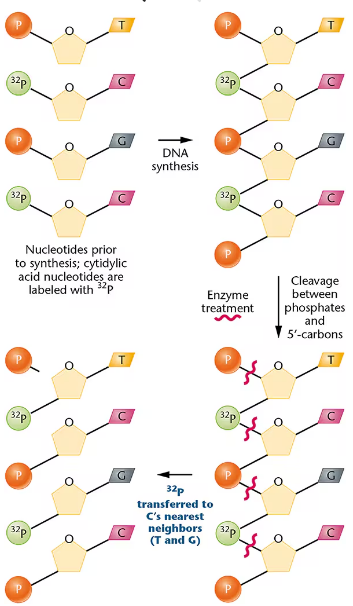
To gauge the fidelity of DNA synthesis, Arthur Kornberg and colleagues devised a technique called nearest-neighbor analysis, which determines the frequency with which any two bases occur adjacent to each other along the polynucleotide chain (J. Biol. Chem. 236: 864–875). This test relies on the enzyme spleen phosphodiesterase (see the previous problem). DNA is synthesized by polymerization of 5'-nucleotides—that is, each nucleotide is added with the phosphate on the deoxyribose. However, as shown in the accompanying figure, the phosphodiesterase enzyme cleaves DNA between the phosphate and the C-5' atom, thereby producing 3'-nucleotides. In this test, the phosphates on only one of the four nucleotide precursors of DNA (cytidylic acid, for example) are made radioactive with ³²P, and DNA is synthesized. Then the DNA is subjected to enzymatic cleavage, in which the radioactive phosphate is transferred to the base that is the 'nearest neighbor' on the 5' side of all cytidylic acid nucleotides.
Diagram showing DNA synthesis from 32P-labeled nucleotides and enzyme cleavage transferring radioactive phosphate to adjacent bases.
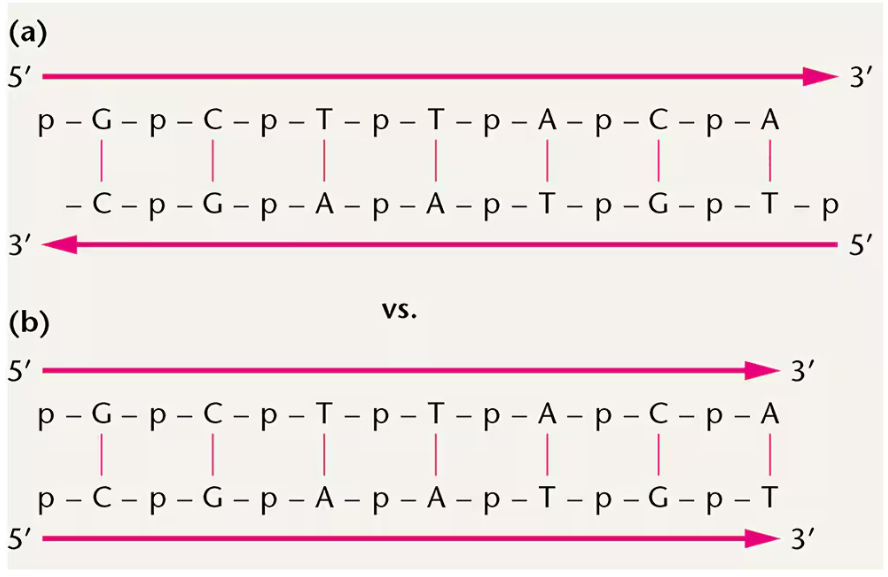
Following four separate experiments, in each of which a different one of the four nucleotide types is radioactive, the frequency of all 16 possible nearest neighbors can be calculated. When Kornberg applied the nearest-neighbor frequency test to the DNA template and resultant product from a variety of experiments, he found general agreement between the nearest-neighbor frequencies of the two. Analysis of nearest-neighbor data led Kornberg to conclude that the two strands of the double helix are in opposite polarity to one another. Demonstrate this approach by determining the outcome of such an analysis if the strands of DNA shown here are (a) antiparallel versus (b) parallel:
Diagram comparing DNA strands in (a) antiparallel and (b) parallel orientations with nucleotide sequences and phosphate links.

Verified step by step guidance
1
Understand the concept of nearest-neighbor analysis: This technique determines the frequency of adjacent nucleotide pairs in a DNA sequence. It involves labeling one type of nucleotide with radioactive phosphorus (³²P), synthesizing DNA, and then enzymatically cleaving the DNA to identify the nucleotide adjacent to the labeled one.
Recognize the role of antiparallel versus parallel DNA strands: In an antiparallel configuration, the two DNA strands run in opposite directions (5' to 3' and 3' to 5'). In a parallel configuration, both strands run in the same direction (5' to 3'). This polarity affects the arrangement of nearest neighbors.
Set up the experiment for antiparallel strands: Label one nucleotide type (e.g., cytidylic acid) with ³²P, synthesize DNA, and cleave it enzymatically. Record the frequency of each nucleotide that appears as the nearest neighbor on the 5' side of the labeled nucleotide. Repeat this for all four nucleotide types.
Set up the experiment for parallel strands: Perform the same steps as in the antiparallel case, but assume both strands run in the same direction. Record the nearest-neighbor frequencies for each labeled nucleotide type.
Compare the results: Analyze the nearest-neighbor frequencies for both configurations. In the antiparallel case, the frequencies of complementary base pairs (e.g., A-T, G-C) will match between the template and product strands, reflecting the complementary and opposite polarity of the strands. In the parallel case, the frequencies will not align in the same way, as the strands are not complementary in the same directional context.

Verified video answer for a similar problem:

This video solution was recommended by our tutors as helpful for the problem above.
Video duration:
1m
Was this helpful?

Key Concepts

Here are the essential concepts you must grasp in order to answer the question correctly.

DNA Structure and Antiparallel Strands

DNA is composed of two strands that form a double helix, with each strand running in opposite directions, known as antiparallel orientation. This means that one strand runs from the 5' to 3' direction, while the complementary strand runs from 3' to 5'. This antiparallel arrangement is crucial for DNA replication and function, as it allows for proper base pairing and enzymatic activity during processes like transcription and replication.
Recommended video:
Guided course
06:25
DNA Structure

Nearest-Neighbor Analysis

Nearest-neighbor analysis is a technique used to study the frequency of adjacent base pairs in a DNA sequence. By labeling one type of nucleotide with a radioactive isotope, researchers can track how often specific bases occur next to each other. This method provides insights into the structural and functional properties of DNA, including the understanding of base pairing and the overall fidelity of DNA synthesis.
Recommended video:
Guided course
02:48
Chi Square Analysis

Phosphodiester Bond and Enzymatic Cleavage

The phosphodiester bond links nucleotides in a DNA strand, connecting the 5' phosphate group of one nucleotide to the 3' hydroxyl group of another. Enzymes like spleen phosphodiesterase can cleave these bonds, resulting in the formation of shorter DNA fragments. Understanding how these enzymes work is essential for analyzing DNA structure and function, as they play a key role in processes such as DNA replication and repair.
Recommended video:
Guided course
06:25
DNA Structure