Pearson+ LogoPearson+ Logo
Ch. 11 - DNA Replication and Recombination
Klug - Concepts of Genetics  12th Edition
Klug12th EditionConcepts of Genetics ISBN: 9780135564776Not the one you use?Change textbook
Chapter 11, Problem 27a

DNA polymerases in all organisms add only 5' nucleotides to the 3' end of a growing DNA strand, never to the 5' end. One possible reason for this is the fact that most DNA polymerases have a proofreading function that would not be energetically possible if DNA synthesis occurred in the 3' to 5' direction.
Sketch the reaction that DNA polymerase would have to catalyze if DNA synthesis occurred in the 3' to 5' direction.

Verified step by step guidance
1
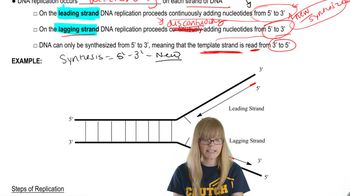
Understand the directionality of DNA synthesis: DNA polymerases synthesize DNA by adding nucleotides to the 3' end of the growing strand, which means the strand grows in the 5' to 3' direction. This is due to the chemical structure of nucleotides and the energy dynamics of the reaction.
Review the chemical structure of nucleotides: Each nucleotide consists of a phosphate group, a sugar (deoxyribose), and a nitrogenous base. The phosphate group is attached to the 5' carbon of the sugar, and the hydroxyl (-OH) group is attached to the 3' carbon. DNA polymerase catalyzes the formation of a phosphodiester bond between the 3' hydroxyl group of the growing strand and the 5' phosphate group of the incoming nucleotide.
Consider the energy requirements for synthesis in the 3' to 5' direction: If DNA synthesis occurred in the 3' to 5' direction, the reaction would require the incoming nucleotide to provide a 3' hydroxyl group for bond formation. This would necessitate a different energy source, as the current mechanism relies on the hydrolysis of the high-energy phosphate bonds in the incoming nucleotide triphosphate (dNTP).
Sketch the hypothetical reaction: In the 3' to 5' synthesis direction, DNA polymerase would need to catalyze the formation of a bond between the 5' phosphate group of the growing strand and the 3' hydroxyl group of the incoming nucleotide. This reaction would likely require a new mechanism for energy transfer, as the current proofreading function relies on the ability to remove mismatched nucleotides from the 3' end, which would not be possible in this scenario.
Reflect on the implications for proofreading: The proofreading function of DNA polymerase depends on the ability to excise mismatched nucleotides from the 3' end of the growing strand. If synthesis occurred in the 3' to 5' direction, removing a mismatched nucleotide would leave a free 5' end, which lacks the high-energy phosphate bonds needed to drive further synthesis. This would make proofreading energetically unfavorable and compromise the fidelity of DNA replication.

Verified video answer for a similar problem:

This video solution was recommended by our tutors as helpful for the problem above.
Video duration:
51s
Was this helpful?

Key Concepts

Here are the essential concepts you must grasp in order to answer the question correctly.

DNA Polymerase Function

DNA polymerases are enzymes responsible for synthesizing new DNA strands by adding nucleotides to the growing chain. They can only add nucleotides to the 3' end of a DNA strand, which means that DNA synthesis occurs in a 5' to 3' direction. This unidirectional synthesis is crucial for maintaining the integrity of the genetic information during replication.
Recommended video:
Guided course
08:26
Functional Genomics

Proofreading Mechanism

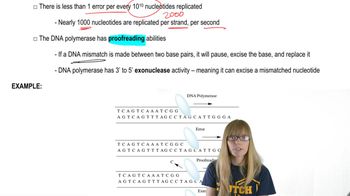
Many DNA polymerases possess a proofreading function that allows them to correct errors during DNA synthesis. This mechanism involves the enzyme's ability to detect and remove incorrectly paired nucleotides. If DNA synthesis were to occur in the 3' to 5' direction, the proofreading process would be less efficient and energetically unfavorable, potentially leading to a higher rate of mutations.
Recommended video:

Directionality of DNA Synthesis

The directionality of DNA synthesis is a fundamental aspect of molecular biology. DNA strands have polarity, with a 5' phosphate group and a 3' hydroxyl group. The requirement for DNA polymerases to synthesize DNA in the 5' to 3' direction ensures that the newly added nucleotides can form the necessary phosphodiester bonds, which are critical for the stability and continuity of the DNA molecule.
Recommended video:
Guided course
05:02
Directionality
Related Practice
Textbook Question

In 1994, telomerase activity was discovered in human cancer cell lines. Although telomerase is not active in most human adult cells, all cells do contain the genes for telomerase proteins and telomerase RNA. Since inappropriate activation of telomerase may contribute to cancer, why do you think the genes coding for this enzyme have been maintained in the human genome throughout evolution? Are there any types of human body cells where telomerase activation would be advantageous or even necessary? Explain.

739
views
Textbook Question

The genome of D. melanogaster consists of approximately 1.7x10⁸ base pairs. DNA synthesis occurs at a rate of 30 base pairs per second. In the early embryo, the entire genome is replicated in five minutes. How many bidirectional origins of synthesis are required to accomplish this feat?

624
views
Textbook Question

Assume a hypothetical organism in which DNA replication is conservative. Design an experiment similar to that of Taylor, Woods, and Hughes that will unequivocally establish this fact. Using the format established in Figure 11.5, draw sister chromatids and illustrate the expected results establishing this mode of replication.

803
views
Textbook Question

DNA polymerases in all organisms add only 5' nucleotides to the 3' end of a growing DNA strand, never to the 5' end. One possible reason for this is the fact that most DNA polymerases have a proofreading function that would not be energetically possible if DNA synthesis occurred in the 3' to 5' direction.

Consider the information in your sketch and speculate as to why proofreading would be problematic.

1786
views
Textbook Question

Assume that the sequence of bases shown below is present on one nucleotide chain of a DNA duplex and that the chain has opened up at a replication fork. Synthesis of an RNA primer occurs on this template starting at the base that is underlined.

If the RNA primer consists of eight nucleotides, what is its base sequence?

3'.......GGCTACCTGGATTCA....5'

669
views
Textbook Question

Assume that the sequence of bases shown below is present on one nucleotide chain of a DNA duplex and that the chain has opened up at a replication fork. Synthesis of an RNA primer occurs on this template starting at the base that is underlined.

In the intact RNA primer, which nucleotide has a free 3'-OH terminus?

3'.......GGCTACCTGGATTCA....5'

760
views