Pearson+ LogoPearson+ Logo
Ch. 11 - DNA Replication and Recombination
Klug - Concepts of Genetics  12th Edition
Klug12th EditionConcepts of Genetics ISBN: 9780135564776Not the one you use?Change textbook
Chapter 11, Problem 26

Assume a hypothetical organism in which DNA replication is conservative. Design an experiment similar to that of Taylor, Woods, and Hughes that will unequivocally establish this fact. Using the format established in Figure 11.5, draw sister chromatids and illustrate the expected results establishing this mode of replication.

Verified step by step guidance
1
Recall that in conservative DNA replication, the original double-stranded DNA molecule remains intact, and an entirely new double-stranded DNA molecule is synthesized. This contrasts with semiconservative replication, where each daughter DNA molecule contains one original and one new strand.
Design an experiment similar to Taylor, Woods, and Hughes by using a labeled nucleotide precursor (such as radioactive thymidine or a heavy isotope like 15N) to distinguish newly synthesized DNA from original DNA. Grow cells in the presence of this label for one round of DNA replication.
After one replication cycle, transfer the cells to a medium without the label and allow them to replicate again. Then, prepare chromosome spreads and use autoradiography to detect the location of the label on sister chromatids.
Draw sister chromatids as pairs of double-stranded DNA molecules. For conservative replication, after one round, one chromatid should be fully labeled (new DNA) and the other fully unlabeled (original DNA). After the second round, you would expect one chromatid fully labeled and the other fully unlabeled in each pair, with no mixing of label within chromatids.
Compare this expected pattern to the semiconservative model (where each chromatid would be half-labeled after one round) to unequivocally establish conservative replication. The key is that in conservative replication, the label is segregated into entirely new DNA molecules, not distributed between strands.

Verified video answer for a similar problem:

This video solution was recommended by our tutors as helpful for the problem above.
Video duration:
2m
Was this helpful?

Key Concepts

Here are the essential concepts you must grasp in order to answer the question correctly.

DNA Replication Models

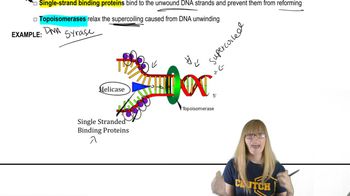
DNA replication can occur via three models: conservative, semi-conservative, and dispersive. In conservative replication, the original DNA molecule remains intact, and an entirely new copy is made. Understanding these models is essential to design experiments that distinguish between them based on the distribution of labeled DNA strands after replication.
Recommended video:
Guided course
11:59
Steps to DNA Replication

Taylor, Woods, and Hughes Experiment

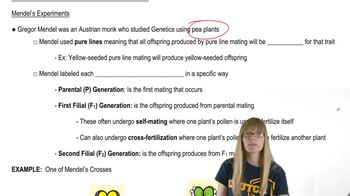
This classic experiment used radioactive thymidine to label DNA in root tip cells and autoradiography to track replication. It demonstrated semi-conservative replication by showing one labeled and one unlabeled chromatid after one replication cycle. Knowing this method helps in designing similar experiments to test alternative replication models.
Recommended video:
Guided course
08:06
Mendel's Experiments

Autoradiography and Chromatid Visualization

Autoradiography detects radioactive labels incorporated into DNA, allowing visualization of newly synthesized strands. Drawing sister chromatids with expected label patterns after replication cycles helps interpret results. For conservative replication, one chromatid would be fully labeled and the other unlabeled, a key visual distinction.
Recommended video:
Related Practice
Textbook Question

Many of the gene products involved in DNA synthesis were initially defined by studying mutant E. coli strains that could not synthesize DNA.

The dnaQ gene encodes the ε subunit of DNA polymerase. What effect is expected from a mutation in this gene?

489
views
Textbook Question

In 1994, telomerase activity was discovered in human cancer cell lines. Although telomerase is not active in most human adult cells, all cells do contain the genes for telomerase proteins and telomerase RNA. Since inappropriate activation of telomerase may contribute to cancer, why do you think the genes coding for this enzyme have been maintained in the human genome throughout evolution? Are there any types of human body cells where telomerase activation would be advantageous or even necessary? Explain.

739
views
Textbook Question

The genome of D. melanogaster consists of approximately 1.7x10⁸ base pairs. DNA synthesis occurs at a rate of 30 base pairs per second. In the early embryo, the entire genome is replicated in five minutes. How many bidirectional origins of synthesis are required to accomplish this feat?

624
views
Textbook Question

DNA polymerases in all organisms add only 5' nucleotides to the 3' end of a growing DNA strand, never to the 5' end. One possible reason for this is the fact that most DNA polymerases have a proofreading function that would not be energetically possible if DNA synthesis occurred in the 3' to 5' direction.

Sketch the reaction that DNA polymerase would have to catalyze if DNA synthesis occurred in the 3' to 5' direction.

665
views
Textbook Question

DNA polymerases in all organisms add only 5' nucleotides to the 3' end of a growing DNA strand, never to the 5' end. One possible reason for this is the fact that most DNA polymerases have a proofreading function that would not be energetically possible if DNA synthesis occurred in the 3' to 5' direction.

Consider the information in your sketch and speculate as to why proofreading would be problematic.

1786
views
Textbook Question

Assume that the sequence of bases shown below is present on one nucleotide chain of a DNA duplex and that the chain has opened up at a replication fork. Synthesis of an RNA primer occurs on this template starting at the base that is underlined.

If the RNA primer consists of eight nucleotides, what is its base sequence?

3'.......GGCTACCTGGATTCA....5'

669
views