
Textbook Question
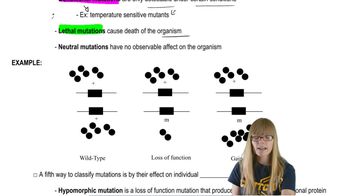
Several temperature-sensitive mutant strains of E. coli display the following characteristics. Predict what enzyme or function is being affected by each mutation.
Newly synthesized DNA contains many mismatched base pairs.
669
views

 Verified step by step guidance
 10:48
10:48
 11:59 10:48
Several temperature-sensitive mutant strains of E. coli display the following characteristics. Predict what enzyme or function is being affected by each mutation.
Newly synthesized DNA contains many mismatched base pairs.
Several temperature-sensitive mutant strains of E. coli display the following characteristics. Predict what enzyme or function is being affected by each mutation.
Okazaki fragments accumulate, and DNA synthesis is never completed.
While many commonly used antibiotics interfere with protein synthesis or cell wall formation, clorobiocin, one of several antibiotics in the aminocoumarin class, inhibits the activity of bacterial DNA gyrase. Similar drugs have been tested as treatments for human cancer. How might such drugs be effective against bacteria as well as cancer?
Several temperature-sensitive mutant strains of E. coli display the following characteristics. Predict what enzyme or function is being affected by each mutation.
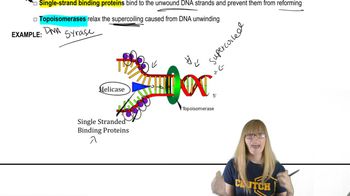
Supercoiled strands remain after replication, which is never completed.
Several temperature-sensitive mutant strains of E. coli display the following characteristics. Predict what enzyme or function is being affected by each mutation.
No initiation occurs.
Describe the 'end-replication problem' in eukaryotes. How is it resolved?