
Textbook Question
Several temperature-sensitive mutant strains of E. coli display the following characteristics. Predict what enzyme or function is being affected by each mutation.
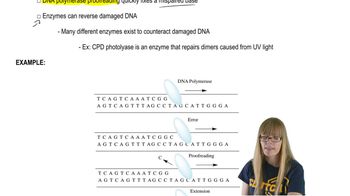
Newly synthesized DNA contains many mismatched base pairs.
669
views

 Verified step by step guidance
 11:59
11:59
 01:45
01:45 10:48
10:48Several temperature-sensitive mutant strains of E. coli display the following characteristics. Predict what enzyme or function is being affected by each mutation.
Newly synthesized DNA contains many mismatched base pairs.
Several temperature-sensitive mutant strains of E. coli display the following characteristics. Predict what enzyme or function is being affected by each mutation.
Synthesis is very slow.
Several temperature-sensitive mutant strains of E. coli display the following characteristics. Predict what enzyme or function is being affected by each mutation.
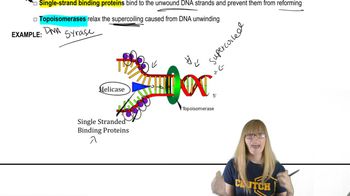
Supercoiled strands remain after replication, which is never completed.
Suppose that E. coli synthesizes DNA at a rate of 100,000 nucleotides per minute and takes 40 minutes to replicate its chromosome.
(a) How many base pairs are present in the entire E. coli chromosome?
(b) What is the physical length of the chromosome in its helical configuration—that is, what is the circumference of the chromosome if it were opened into a circle?
Why is DNA synthesis expected to be more complex in eukaryotes than in bacteria? How is DNA synthesis similar in the two types of organisms?
Several temperature-sensitive mutant strains of E. coli display the following characteristics. Predict what enzyme or function is being affected by each mutation.
No initiation occurs.