
Textbook Question
How many base pairs are in a molecule of phage T2 DNA 52-µm long?
838
views

 Verified step by step guidance
 07:10
07:10
 07:55
07:55 08:41
08:41How many base pairs are in a molecule of phage T2 DNA 52-µm long?
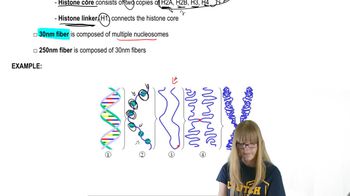
Describe the molecular composition and arrangement of the components in the nucleosome.
Assume that a viral DNA molecule is a 50-µm-long circular strand with a uniform 20-Å diameter. If this molecule is contained in a viral head that is a 0.08-µm-diameter sphere, will the DNA molecule fit into the viral head, assuming complete flexibility of the molecule? Justify your answer mathematically.
Describe the transitions that occur as nucleosomes are coiled and folded, ultimately forming a chromatid.
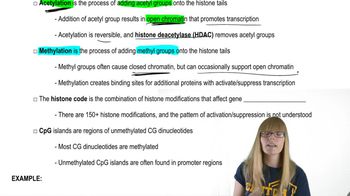
Examples of histone modifications are acetylation (by histone acetyltransferase, or HAT), which is often linked to gene activation, and deacetylation (by histone deacetylases, or HDACs), which often leads to gene silencing typical of heterochromatin. Such heterochromatinization is initiated from a nucleation site and spreads bidirectionally until encountering boundaries that delimit the silenced areas. In the brief discussion of position effect, where repositioning of the w⁺ allele in Drosophila by translocation or inversion near heterochromatin produces intermittent w⁺ activity. In the heterozygous state (w⁺/w) a variegated eye is produced, with white and red patches. How might one explain position-effect variegation in terms of histone acetylation and/or deacetylation?
Provide a comprehensive definition of heterochromatin and list as many examples as you can.